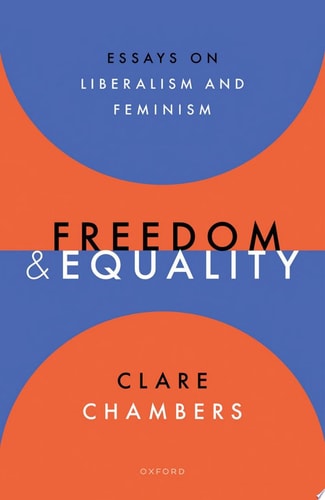
Freedom and Equality: Essays on Liberalism and Feminism
0
0
As an Amazon Associate and affiliate partner, Menrva Books earns from qualifying purchases. Learn more
Author Description
Should the state recognise gender? Can a liberal state discourage traditional family structures? Is women's sport compatible with equality of opportunity? Should feminists defend women's freedom to choose cosmetic surgery? Is genital cutting always wrong, or is it only wrong for girls?Freedom and Equality investigates the contours of feminist liberalism: a philosophical approach that is appealing but elusive. Its hallmark is a liberalism that prioritises equality and individual autonomy, while offering a rigorous critique of using individuals' choices as the measure of justice. Liberalism without feminism prioritises individual choice, a strategy that has played a crucial role in the liberal defence of freedom against authoritarianism and conformity. However, as feminism shows, relying on individual choice is insufficient to render an outcome just, because people often choose things that harm or disadvantage themselves. From beauty norms to the gendered division of labour, from marriage to religion, women and men choose to arrange their lives in ways that perpetuate inequality. Often, these choices are made in response to social norms, including unjust, unequal, or harmful norms. It follows that relying on individual choice as a measure of justice actually leaves unjust social structures intact. Any defender of autonomy and equality must be prepared to criticise individuals' choices while prioritising individual choosers.The essays in this collection cover a wide range of issues fundamental to liberalism, to feminism, and to their intersection. They explore the foundational philosophical concepts of choice, equality of opportunity, ideology, and the state, and they engage directly with key political controversies, including women's sport, the state recognition of gender, the regulation of cosmetic and cultural surgeries, and state action to secure equality in the family. Clare Chambers argues that feminist liberalism is both possible and necessary.
Menrva's Summary
THE THESIS
This collection investigates the philosophical compatibility of liberalism and feminism, specifically questioning whether a state can prioritize individual autonomy while simultaneously critiquing the choices that perpetuate social inequality. Clare Chambers, a professor of political philosophy, utilizes a framework of feminist liberalism to examine how social norms influence individual decision-making. She argues that traditional liberal reliance on individual choice as the sole metric of justice is insufficient, as it often ignores the systemic pressures that lead individuals to choose outcomes that disadvantage them.
THE SCOPE MAP
What You Will Find
- Philosophical analysis of concepts including choice, equality of opportunity, and ideology.
- Examination of state intervention in gender recognition and family structures.
- Discussion of cultural and cosmetic surgeries through a feminist lens.
- Critique of the gendered division of labor and beauty norms.
Scope Limits
- The text focuses primarily on Western liberal democratic frameworks.
- It does not provide a comprehensive policy manual but rather a theoretical foundation for political debate.
THE AUTHORITY PERSPECTIVE
Scholars and political theorists frequently cite this work as a rigorous contribution to the intersection of liberal theory and feminist critique. Readers often note the academic density of the prose, which is well-suited for students and researchers in political philosophy.
Page Count:
368
Publication Date:
2024-01-01
Publisher:
Oxford University Press
ISBN-10:
019289790X
ISBN-13:
9780192897909
Politics
Philosophy
Political Philosophy
Ethics
Social justice
Feminism
Liberalism
Gender Studies
Ethics & Morality
Community Tags
Similar Books