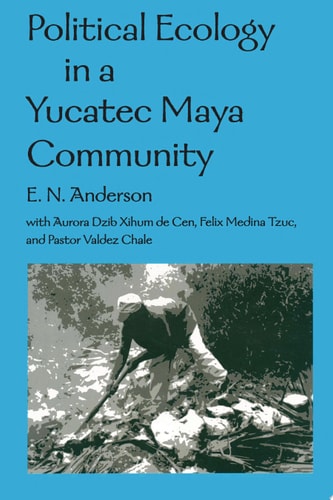
Political Ecology in a Yucatec Maya Community
0
0
As an Amazon Associate and affiliate partner, Menrva Books earns from qualifying purchases. Learn more
Author Description
In Chunhuhub, the Conquest is not a done deal. Unlike many small tropical towns, Chunhuhub in rural Quintana Roo, Mexico, has not been a helpless victim of international forces. Its people are descendants of heroic Mayans who stood off the Spanish invaders. People in Chunhuhub continue to live largely through subsistence farming of maize and vegetables, supplemented by commercial orchard, livestock, and field crop cultivation. They are, however, also self-consciously “modernizing” by seeking better educational and economic opportunities. Political Ecology in a Yucatec Maya Community tells the story of Chunhuhub at the beginning of the twenty-first century, focusing on the resource management of plants and animals. E. N. Anderson and his Maya co-authors provide a detailed overview of Maya knowledge of and relationships with the environment, describing how these relationships have been maintained over the centuries and are being transformed by modernization. They show that the Quintana Roo Mayas have been working to find ways to continue ancient and sustainable methods of making a living while also introducing modern techniques that can improve that living. For instance, traditional subsistence agriculture is broadly sustainable at current population densities, but hunting is not, and modern mechanized agriculture has an uncertain future. Bringing the voice of contemporary Mayas to every page, the authors offer an encyclopedic overview of the region: history, environment, agriculture, medicine, social relations, and economy. Whether discussing the fine points of beekeeping or addressing the problem of deforestation, they provide a remarkably detailed account that immerses readers in the landscape. Maya of the Yucatán Peninsula have had more than their share of successes—and some failures as well—and as a study in political and cultural ecology, Political Ecology in a Yucatec Maya Community has much to tell us about tropical development and about the human condition.
Menrva's Summary
THE THESIS
This book investigates how the Yucatec Maya community of Chunhuhub navigates the complexities of modernization while striving to maintain their traditional resource management practices and cultural identity. Authored by E. N. Anderson and his Maya co-authors, the work draws upon extensive ethnographic research and deep local knowledge to detail the community's historical relationship with their environment. It presents an argument for the resilience and adaptability of Maya ecological knowledge, demonstrating how ancient sustainable methods are being integrated with modern techniques to improve livelihoods. The book examines the delicate balance between subsistence farming, commercial agriculture, and the challenges posed by modernization, offering a nuanced perspective on tropical development.
THE SCOPE MAP
- Detailed overview of Maya knowledge and relationships with plants and animals in Chunhuhub.
- Analysis of historical and contemporary resource management practices, including subsistence farming, orchard cultivation, livestock, and field crops.
- Exploration of how modernization is transforming traditional Maya livelihoods and environmental interactions.
- Insights into the region's history, environment, agriculture, medicine, social relations, and economy from a Maya perspective.
- Case studies on specific practices like beekeeping and the challenges of deforestation.
- An encyclopedic account of the Yucatec Maya of the Yucatán Peninsula.
THE AUTHORITY PERSPECTIVE
This work is recognized for its detailed, encyclopedic overview of a Yucatec Maya community, offering a rich ethnographic account of their resource management and adaptation to modernization. The inclusion of Maya co-authors provides an authentic voice, detailing their historical and contemporary relationships with the environment. The book is valued for its nuanced examination of how ancient sustainable methods are being integrated with modern techniques, offering insights into tropical development and the human condition.
Page Count:
296
Publication Date:
2005-10-01
Publisher:
University of Arizona Press
ISBN-10:
0816543364
ISBN-13:
9780816543366
History
Science
Non-Fiction
Anthropology
Modernization
Subsistence Farming
Community Tags
Similar Books















Reader Comments
Share Your Thoughts
No comments yet. Be the first to share your thoughts!