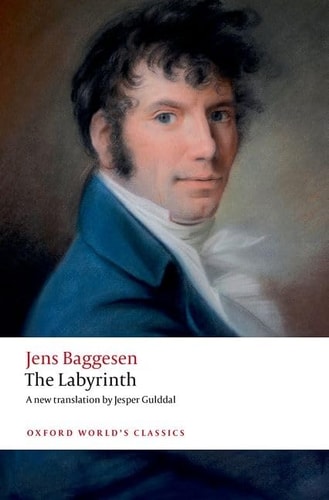
The Labyrinth
0
0
As an Amazon Associate and affiliate partner, Menrva Books earns from qualifying purchases. Learn more
Author Description
This travel book is truly a labyrinth--or, more precisely, a piece of the labyrinth that it has been my fate to wander, from the cradle to the grave.'Jens Baggesen's The Labyrinth (1792-93) is a genre-bending and highly personal travel book that follows the young Danish author's journey, made in 1789, from Copenhagen through Germany to the Swiss border at Basel. In its outer form, it follows the conventions of travel writing: describing the cities, landscapes, and notable people encountered on the route, while also offering critical commentary on art, architecture, theatre, and literature, mixed with reactions to the unfolding French Revolution. However, Baggesen finds contemporary travel writing to be pedantic and dry and is determined to make his own account as engaging and personal as possible. Based on the principle that 'nothing is more necessary in a volume of travels than a traveller', the narrative eschews a focus on prescribed sights and instead foregrounds his individual responses to the places and people he encounters. Baggesen's account of his journey is not simply sentimental, but rather moves through an array of different, often conflicting affective and intellectual register: from dejection to wit, whimsy, and ebullient joy, including enchanted observations of nature as well as cosmopolitan reveries about the brotherhood of nations. Similarly, the prose style of the book---always acknowledged as a key feature--is determinedly eclectic. A richly varied compendium of literary styles, attitudes, and philosophical ideas, brought to life in a new English translation by Jesper Gulddal, The Labyrinth offers a rare glimpse into the mind of an endlessly thinking, feeling, and imagining traveller at a pivotal moment in European history.ABOUT THE SERIES: For over 100 years Oxford World's Classics has made available the widest range of literature from around the globe. Each affordable volume reflects Oxford's commitment to scholarship, providing the most accurat
Menrva's Summary
THE THESIS
How can a travel narrative transcend the pedantic conventions of the 18th-century genre to capture the authentic, shifting consciousness of the traveler? Jens Baggesen, a Danish author, utilizes his 1789 excursion from Copenhagen to the Swiss border as a framework to explore the intersection of personal subjectivity and historical observation. By prioritizing his internal emotional and intellectual reactions over objective descriptions of landmarks, he argues that the traveler's own mind is the most critical component of the travelogue.
THE SCOPE MAP
What You Will Find
- A detailed account of an 18th-century journey from Copenhagen through Germany to Basel.
- Critical commentary on European art, architecture, theater, and literature of the period.
- Observations on the social and political climate during the onset of the French Revolution.
Scope Limits
- The text does not function as a traditional guidebook or a comprehensive historical survey of the regions visited.
- It does not maintain a singular, consistent tone, shifting frequently between wit, dejection, and philosophical reverie.
THE AUTHORITY PERSPECTIVE
Scholars and critics recognize this work as a significant example of genre-bending literature that challenges the rigid structures of Enlightenment-era travel writing. Readers frequently note the eclectic and highly personal nature of the prose, which serves as a foundational text for understanding the transition toward more subjective, introspective narrative styles.
Page Count:
528
Publication Date:
2025-04-09
Publisher:
Oxford University Press
ISBN-10:
0192898515
ISBN-13:
9780192898517
Memoir
Philosophy
Non-Fiction
Travel Writing
Danish Literature
18th century
Essays
Community Tags
Other Editions(2)
Similar Books




Reader Comments
Share Your Thoughts
No comments yet. Be the first to share your thoughts!