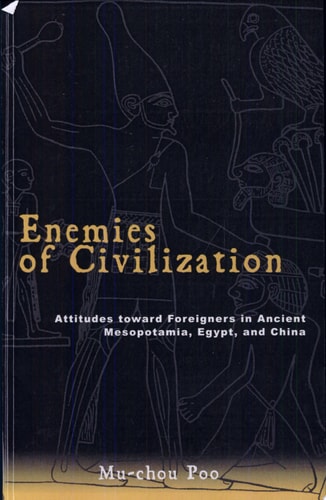
Enemies of Civilization
0
0
As an Amazon Associate and affiliate partner, Menrva Books earns from qualifying purchases. Learn more
Author Description
Looks at how foreigners were regarded in three ancient civilizations, finding that cultural, not biophysical, differences were key in distinguishing "us" from "them." Enemies of Civilization is a work of comparative history and cultural consciousness that discusses how "others" were perceived in three ancient civilizations: Mesopotamia, Egypt, and China. Each civilization was the dominant culture in its part of the world, and each developed a mind-set that regarded itself as culturally superior to its neighbors. Mu-chou Poo compares these societies' attitudes toward other cultures and finds differences and similarities that reveal the self-perceptions of each society. Notably, this work shows that in contrast to modern racism based on biophysical features, such prejudice did not exist in these ancient societies. It was culture rather than biophysical nature that was the most important criterion for distinguishing us from them. By examining how societies conceive their prejudices, this book breaks new ground in the study of ancient history and opens new ways to look at human society, both ancient and modern.
Menrva's Summary
THE THESIS
This book investigates how foreigners were perceived in Mesopotamia, Egypt, and China, challenging the notion of inherent ancient racism. Mu-chou Poo's comparative history examines the dominant cultures of these three ancient civilizations and their self-perceived superiority. The work contrasts their attitudes toward neighboring cultures, highlighting both similarities and differences that illuminate each society's self-image. Crucially, the book argues that unlike modern racism rooted in physical characteristics, ancient prejudice was primarily based on cultural distinctions rather than inherent biological traits.
THE SCOPE MAP
- Comparative analysis of foreign perception in Mesopotamia, Egypt, and China.
- Examination of cultural superiority complexes in dominant ancient societies.
- Identification of similarities and differences in attitudes toward 'others'.
- Argument against the existence of biophysical racism in these ancient civilizations.
- Focus on culture as the primary differentiator between 'us' and 'them'.
- Insights into the self-perception of ancient societies.
- New perspectives on the study of ancient history and human society.
THE AUTHORITY PERSPECTIVE
This work is recognized for its novel approach to understanding ancient prejudice, moving beyond simplistic notions of racism. By focusing on cultural distinctions rather than physical ones, Poo offers a nuanced perspective on how ancient civilizations defined their 'other'. The comparative method applied to Mesopotamia, Egypt, and China provides a broad scope for analysis. This study is positioned to reshape discussions on ancient history and societal self-perception.
Page Count:
229
Publication Date:
2012-02-01
Publisher:
State University of New York Press (SUNY Press)
ISBN-10:
0791483703
ISBN-13:
9780791483701
Non-Fiction
History
Sociology
Community Tags
Similar Books