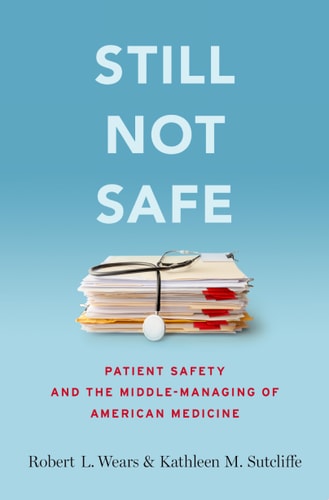
Still Not Safe: Patient Safety and the Middle-Managing of American Medicine
1
0
As an Amazon Associate and affiliate partner, Menrva Books earns from qualifying purchases. Learn more
Author Description
The term "patient safety" rose to popularity in the late nineties, as the medical community -- in particular, physicians working in nonmedical and administrative capacities -- sought to raise awareness of the tens of thousands of deaths in the US attributed to medical errors each year. But what was causing these medical errors? And what made these accidents to rise to epidemic levels, seemingly overnight? Still Not Safe is the story of the rise of the patient-safety movement -- and how an "epidemic" of medical errors was derived from a reality that didn't support such a characterization. Physician Robert Wears and organizational theorist Kathleen Sutcliffe trace the origins of patient safety to the emergence of market trends that challenged the place of doctors in the larger medical ecosystem: the rise in medical litigation and physicians' aversion to risk; institutional changes in the organization and control of healthcare; and a bureaucratic movement to "rationalize" medical practice -- to make a hospital run like a factory. If these social factors challenged the place of practitioners, then the patient-safety movement provided a means for readjustment. In spite of relatively constant rates of medical errors in the preceding decades, the "epidemic" was announced in 1999 with the publication of the Institute of Medicine report To Err Is Human; the reforms that followed came to be dominated by the very professions it set out to reform. Weaving together narratives from medicine, psychology, philosophy, and human performance, Still Not Safe offers a counterpoint to the presiding, doctor-centric narrative of contemporary American medicine. It is certain to raise difficult, important questions around the state of our healthcare system -- and provide an opening note for other challenging conversations.
Menrva's Summary
THE THESIS
This book investigates the origins and socio-political motivations behind the emergence of the patient-safety movement in American medicine. Authors Robert Wears and Kathleen Sutcliffe, a physician and an organizational theorist respectively, argue that the narrative of a sudden epidemic of medical errors was a constructed response to shifting market pressures and bureaucratic control rather than a reflection of a new clinical reality. They utilize historical data and organizational analysis to demonstrate how the movement served to reassert administrative control over medical practice.
THE SCOPE MAP
What You Will Find
- Analysis of the 1999 Institute of Medicine report To Err Is Human
- Examination of the rise of medical litigation and risk aversion
- Theoretical framework regarding the rationalization of hospital management
- Interdisciplinary synthesis of medicine, psychology, and human performance studies
Scope Limits
- The book does not provide a clinical manual for reducing specific medical errors
- It does not focus on patient-centered outcomes outside of the administrative context
THE AUTHORITY PERSPECTIVE
Experts and reviewers recognize this work as a critical, provocative challenge to the standard institutional history of patient safety. Readers frequently note the academic density of the prose, which requires a foundational understanding of organizational theory to fully appreciate the authors' arguments.
Page Count:
304
Publication Date:
2019-01-01
Publisher:
Oxford University Press
ISBN-10:
0190271280
ISBN-13:
9780190271282
History
Medical
Medicine
Public Health
Organizational Theory
Allied Health
Healthcare Policy
Sociology
Medicine history
Community Tags
Similar Books