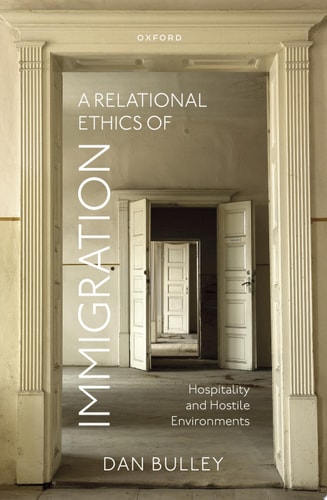
A Relational Ethics of Immigration: Hospitality and Hostile Environments
0
0
As an Amazon Associate and affiliate partner, Menrva Books earns from qualifying purchases. Learn more
Author Description
To understand the ethics of immigration, we need to start from the way it is enacted and understood by everyday actors: through practices of hospitality and hostility. Drawing on feminist and poststructuralist understandings of ethics and hospitality, this book offers a new approach to immigration ethics by exploring state and societal responses to immigration from the Global North and South. Rather than treating ethics as a determinable code for how we ought to behave toward strangers, it explores hospitality as a relational ethics―an ethics without moralism―that aims to understand and possibly transform the way people already do embrace and deflect obligations and responsibilities to each other. Building from specific examples in Colombia, Turkey, and Tanzania, as well as the EU, US and UK, hospitality is developed as a structural and emotional practice of drawing and redrawing boundaries of inside and outside; belonging and non-belonging. It thereby actively creates a society as a communal space with a particular ethos: from a welcoming home to a racialised hostile environment. Hospitality is therefore treated as a critical mode of reflecting on how we create a 'we' and relate to others through entangled histories of colonialism, displacement, friendship, and exploitation. Only through such a reflective understanding can we seek to transform immigration practices to better reflect the real and aspirational ethos of a society. Instead of simple answers―removing borders or creating global migration regimes―the book argues for grounded negotiations that build from existing local capacities to respond to immigration.
Menrva's Summary
THE THESIS
This book investigates how the ethics of immigration are constructed through the everyday practices of hospitality and hostility rather than through abstract moral codes. Dan Bulley, a scholar in international relations, utilizes feminist and poststructuralist frameworks to analyze how state and societal actors negotiate boundaries of belonging. By examining the entangled histories of colonialism and displacement, the author argues that hospitality functions as a relational practice that defines the ethos of a society, ranging from inclusive communal spaces to exclusionary hostile environments.
THE SCOPE MAP
What You Will Find
- Comparative analysis of immigration responses in Colombia, Turkey, Tanzania, the EU, the UK, and the US
- A theoretical framework defining hospitality as a structural and emotional practice
- Examination of how boundaries of inside and outside are redrawn in contemporary political contexts
Scope Limits
- The text does not propose universal policy solutions or global migration regimes
- It avoids prescriptive moralism in favor of grounded, local-level negotiations
THE AUTHORITY PERSPECTIVE
Scholars in the field of political theory and migration studies recognize this work as a significant contribution to the poststructuralist critique of border politics. Readers frequently note the academic density of the prose, which is intended for an audience familiar with critical theory and international relations discourse.
Page Count:
208
Publication Date:
2024-01-01
Publisher:
Oxford University Press
ISBN-10:
019289000X
ISBN-13:
9780192890009
Politics
World politics
Ethics
Sociology
International relations
Community Tags
Similar Books