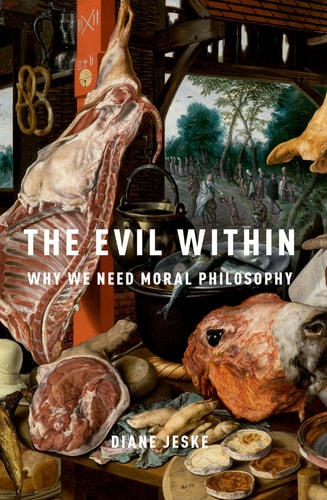
The Evil Within: Why We Need Moral Philosophy
0
0
As an Amazon Associate and affiliate partner, Menrva Books earns from qualifying purchases. Learn more
Author Description
Thomas Jefferson and Edward Coles were men of similar backgrounds, yet they diverged on the central moral wrong of this country's history: the former remained a self-justified slave-holder, while the latter emancipated his slaves.What led these men of the same era to choose such different paths? They represent one of numerous examples in this work wherein examining the ways in which people who perform wrong and even evil actions attempt to justify those actions both to others and to themselves illuminates the mistakes that we ourselves make in moral reasoning. How do we justify moral wrongdoing to ourselves? Do we even notice when we are doing so?The Evil Within demonstrates that the study of moral philosophy can help us to identify and correct for such mistakes. In applying the tools of moral philosophy to case studies of Nazi death camp commandants, American slave-holders, and a psychopathic serial killer, Diane Jeske shows how we can become wiser moral deliberators. A series of case studies serve as extended real-life thought experiments of moral deliberation gone awry, and show us how four impediments to effective moral deliberation--cultural norms and pressures, the complexity of the consequences of our actions, emotions, and self-deception--can be identified and overcome by the study and application of moral philosophy. Jeske unsparingly examines the uncomfortable parellels between the moral deliberations of those who are transparently evil (e.g. psychopaths, Nazis), and our own moral justifications.The Evil Within ultimately argues for incorporating moral philosophy into moral education, so that its tools can become common currency in moral deliberation, discussion, and debate.
Menrva's Summary
THE THESIS
How can the study of moral philosophy help individuals identify and correct the cognitive errors used to justify wrongdoing? Diane Jeske, a professor of philosophy, utilizes historical and psychological case studies to argue that moral philosophy provides the necessary tools to recognize self-deception and flawed reasoning. By examining the justifications used by historical figures and criminals, the author demonstrates how common impediments to moral deliberation can be mitigated through rigorous philosophical inquiry.
THE SCOPE MAP
What You Will Find
- Analysis of moral justifications used by Nazi commandants, American slave-holders, and serial killers.
- A framework for identifying four primary impediments to moral deliberation: cultural norms, complex consequences, emotions, and self-deception.
- Arguments for the integration of moral philosophy into standard educational curricula.
Scope Limits
- The text does not provide a comprehensive history of the specific figures mentioned, focusing instead on their moral reasoning processes.
- It does not offer a universal moral code but rather a methodology for individual moral deliberation.
THE AUTHORITY PERSPECTIVE
Scholars and readers note that the text provides a rigorous, accessible application of philosophical tools to real-world ethical failures. Experts highlight the work as a practical contribution to moral education that bridges the gap between abstract theory and personal decision-making.
Page Count:
298
Publication Date:
2019-08-29
Publisher:
Oxford University Press
ISBN-10:
0190074132
ISBN-13:
9780190074135
Non-Fiction
Philosophy
Politics
New Used & Rental Textbooks
Social Science
Good & Evil
Ethics & Morality
Ethics