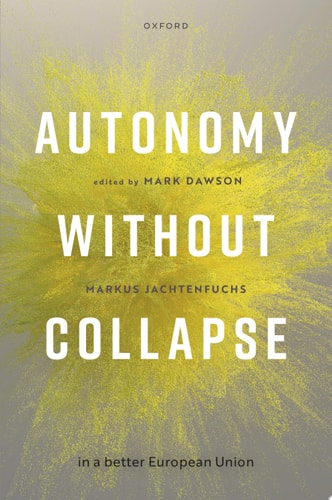
Autonomy without Collapse in a Better European Union
0
0
As an Amazon Associate and affiliate partner, Menrva Books earns from qualifying purchases. Learn more
Author Description
The European Union's history exhibits numerous episodes in which Member States have sought to re-enforce their national autonomy in the face of deepening integration. Efforts to re-gain autonomy, however, are often accompanied by legitimate concerns that autonomy will lead to dis-integration or will have wider destructive consequences. The EU thus faces a dilemma. Calls for autonomy cannot all be dismissed as mere populist rhetoric or national egoism but instead represent a legitimate questioning of the degree of uniformity that EU law and politics presently carry. At the same time, the fear that greater autonomy may carry dis-integrative effects is also legitimate -uniformity is not an accidental by-product of the EU's construction but intrinsically related to its policy goals. Giving too much room for autonomy might create an opportunity structure for the loss of collective goods, deficits in problem-solving, and perhaps even to self-destruction.The EU requires autonomy, but in doing so, it must also avoid collapse. Can it achieve it, and if so, how? Autonomy without Collapse is devoted to exploring innovative answers to this question. It draws together scholars in law and political science interested in exploring how to overcome the central dilemma of preserving sustainable yet real autonomy in the future European Union.
Menrva's Summary
THE THESIS
Can the European Union reconcile the demand for increased national autonomy with the necessity of maintaining institutional cohesion and preventing systemic collapse? The authors, Mark Dawson and Markus Jachtenfuchs, utilize their expertise in law and political science to examine the tension between national sovereignty and supranational integration. They argue that the current EU framework requires a structural recalibration to accommodate legitimate national interests without triggering the disintegration of collective policy goals.
THE SCOPE MAP
What You Will Find
- Analysis of the historical tension between Member State autonomy and EU integration.
- Theoretical frameworks for balancing national flexibility with supranational uniformity.
- Interdisciplinary perspectives from legal scholars and political scientists.
Scope Limits
- The text does not provide a singular, definitive policy blueprint for all EU member states.
- It does not focus on the internal political dynamics of non-EU nations.
THE AUTHORITY PERSPECTIVE
Experts identify this work as a significant contribution to the ongoing debate regarding the future of European governance and the limits of integration. Readers frequently note the academic density of the prose, which is intended for scholars and policy practitioners interested in the mechanics of EU law.
Page Count:
208
Publication Date:
2022-01-01
Publisher:
Oxford University Press
ISBN-10:
0192897543
ISBN-13:
9780192897541
International relations
European Union
Governance
Public Policy
Community Tags
Similar Books