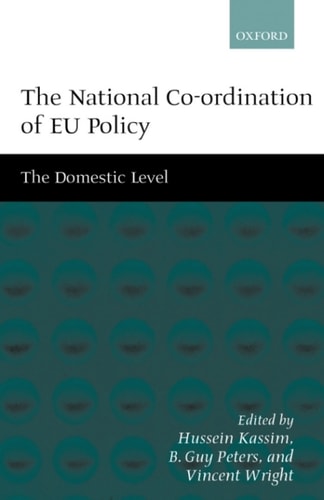
The National Co-ordination of EU Policy: Volume 2: The European Level
0
0
As an Amazon Associate and affiliate partner, Menrva Books earns from qualifying purchases. Learn more
Author Description
This book is one of two volumes in which leading scholars examine the way in which EU member states co-ordinate their European policies. Eschewing the 'Europeanisation' problematic within which the issue is usually addressed, this book adopts a broader, more inclusive approach. It examines domestic processes and investigates co-ordination in ten member states - Austria, Belgium, Denmark, France, Germany, Greece, Italy, Portugal, Spain and the United Kingdom - looking at co-ordinating ambitions, the actors involved in EU policy making, and the structures and processes by which policy is made. From a comparative perspective, the book identifies and assesses the impact of the influences that have shaped systems of national co-ordination - the demands exerted by Union membership, the institutional structure of the national polity, the pre-existing balance between domestic institutions, administrative norms and values, and attitudes, both popular and elite, the European integration. It assesses the extent to which there has been a convergent response to the administrative challenges posed by membership on the part of the member states or whether a pattern of divergence emerges. The effectiveness of member states in influencing policy outcomes at the European level is also addressed. The companion volume answers similar questions about national administrations in Brussels. Looking at twelve member states, it is the first systematic examination of the role played by Permanent Representations in national EU policy making.
Menrva's Summary
THE THESIS
This volume investigates how European Union member states organize and manage their national policy-making processes in relation to EU-level demands. The authors, prominent scholars in political science and public administration, utilize a comparative framework to analyze the administrative structures of ten member states. By moving beyond the standard 'Europeanisation' discourse, the text argues that national coordination is shaped by a complex interplay of institutional history, administrative norms, and the specific pressures of Union membership.
THE SCOPE MAP
What You Will Find
- Comparative analysis of policy coordination in Austria, Belgium, Denmark, France, Germany, Greece, Italy, Portugal, Spain, and the United Kingdom.
- Examination of the actors, structures, and processes involved in national EU policy formulation.
- Assessment of the tension between convergent administrative responses and persistent national divergence.
Scope Limits
- This volume focuses on domestic-level coordination and does not provide an exhaustive analysis of the Brussels-based Permanent Representations, which are covered in the companion volume.
THE AUTHORITY PERSPECTIVE
Experts recognize this work as a foundational comparative study for understanding the administrative mechanics of EU member states. Readers frequently note the academic density of the prose and the systematic rigor applied to the cross-national analysis.
Page Count:
376
Publication Date:
2002-01-01
Publisher:
Oxford University Press
ISBN-10:
0191522716
ISBN-13:
9780191522710
Governance
International relations
Public Policy
European Union
Public Administration
Community Tags
Similar Books