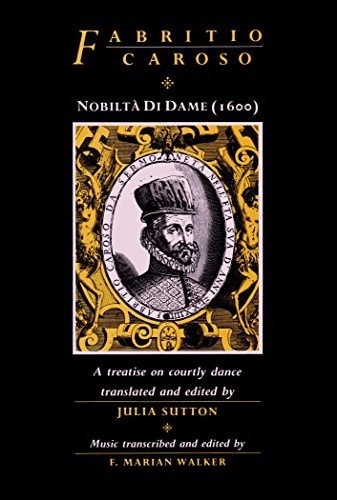
Nobiltà di Dame: A Treatise on Courtly Dance, Together with the Choreography and Music of 49 Dances
0
0
As an Amazon Associate and affiliate partner, Menrva Books earns from qualifying purchases. Learn more
Author Description
Fabritio Caroso was dancing master to some of the greatest princely families of Italy, and Nobiltà di dame, his sumptuous collection of ballroom dances and their music, reflects an age that believed that the person of high rank should be a work of art, uniting strength and beauty. Caroso's detailed instructions (including rules for steps, style and etiquetter, and forty-eight actual choreographies) are unequalled by any contemporary manual in their specificity and clarity. Most dances are preceeded by an engraving showing the opening position and illustrating many aspects of dress, posture, and gesture. A full scholarly apparatus, giving new information unavailable elsewhere, makes the book even more valuable to dancers and to students of dance and music at the junction of the Renaissance and Baroque eras.
Menrva's Summary
THE THESIS
This treatise investigates the technical and social requirements of courtly dance as a manifestation of aristocratic identity during the transition from the Renaissance to the Baroque era. Fabritio Caroso, a prominent Italian dancing master, presents a comprehensive framework that codifies the physical movements, social etiquette, and musical accompaniment necessary for individuals of high rank to perform with grace and precision.
THE SCOPE MAP
What You Will Find
- Detailed technical instructions for 49 specific ballroom dances
- Rules governing posture, gesture, and social conduct in courtly settings
- Historical engravings illustrating opening positions and period fashion
- Musical notation and choreographic sequences for period-accurate performance
Scope Limits
- The text does not cover folk or peasant dance traditions of the period
- It does not provide a general history of Italian social structures beyond the context of the ballroom
THE AUTHORITY PERSPECTIVE
Scholars and dance historians identify this work as a foundational primary source for understanding late sixteenth-century performance practice. Readers frequently note the technical density of the instructions, which require significant study to interpret for modern application.
Page Count:
362
Publication Date:
1986-04-10
Publisher:
Oxford University Press
ISBN-10:
019311917X
ISBN-13:
9780193119178
History
Music
Etiquette
Baroque
Dance
Renaissance
Community Tags
Similar Books