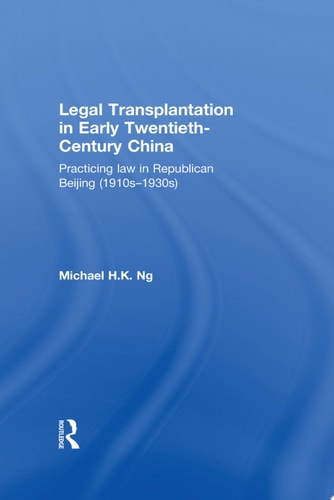
Legal Transplantation in Early Twentieth-Century China: Practicing Law in Republican Beijing (1910s-1930s)
0
0
As an Amazon Associate and affiliate partner, Menrva Books earns from qualifying purchases. Learn more
Author Description
Practicing law" has a dual meaning in this book. It refers to both the occupational practice of law and the practicing of transplanted laws and institutions to perfect them. The book constitutes the first monographic work on the legal history of Republican Beijing, and provides an in-depth and comprehensive account of the practice of law in the city of Beijing during a period of social transformation. Drawing upon unprecedented research using archived records and other primary materials, it explores the problems encountered by Republican Beijing’s legal practitioners, including lawyers, policemen, judges and criminologists, in applying transplanted laws and legal institutions when they were inapplicable to, incompatible with, or inadequate for resolving everyday legal issues. These legal practitioners resolved the mismatch, the author argues, by quite sensibly assimilating certain imperial laws and customs and traditional legal practices into the daily routines of the recently imported legal institutions. Such efforts by indigenous legal practitioners were crucial in, and an integral part of, the making of legal transplantation in Republican Beijing. This work not only makes significant contributions to scholarship on the legal history of modern China, but also offers insights into China’s quest for modernization in its first wave of legal globalization. It is thus of great value to legal historians, comparative legal scholars, specialists in Chinese law and China studies, and lawyers and law students with an interest in Chinese legal history.
Menrva's Summary
THE THESIS
This book investigates how legal practitioners in Republican Beijing adapted transplanted Western legal systems to local realities between the 1910s and 1930s. Michael Ng's work, the first monographic study of Republican Beijing's legal history, examines the challenges faced by lawyers, police, judges, and criminologists. These professionals grappled with applying foreign laws and institutions that were often ill-suited to everyday legal issues in a period of significant social change. Ng argues that practitioners sensibly integrated elements of imperial laws, customs, and traditional practices into the new legal framework, a process crucial to the success of legal transplantation in the era.
THE SCOPE MAP
- An in-depth account of legal practice in Republican Beijing (1910s-1930s).
- Analysis of the challenges faced by lawyers, policemen, judges, and criminologists.
- Exploration of the assimilation of imperial laws and customs into new legal institutions.
- Insights into China's quest for modernization and its first wave of legal globalization.
- Primary source research using archived records.
THE AUTHORITY PERSPECTIVE
This work is recognized for its significant contributions to the scholarship on modern Chinese legal history and comparative legal studies. It offers valuable insights into China's modernization efforts during its initial phase of legal globalization. The book is considered essential reading for legal historians, comparative legal scholars, specialists in Chinese law and China studies, and students interested in Chinese legal history.
Page Count:
142
Publication Date:
2014-05-23
Publisher:
Routledge
ISBN-10:
1317674960
ISBN-13:
9781317674962
Non-Fiction
History
Modern China
Legal History
Chinese Law
Community Tags
Similar Books