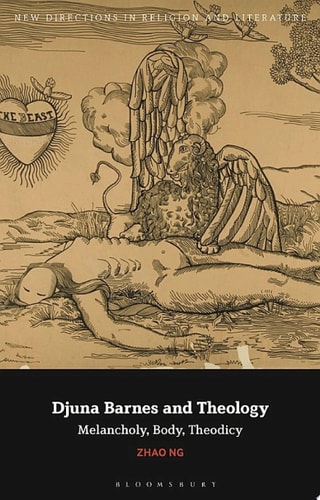
Djuna Barnes and Theology
0
0
As an Amazon Associate and affiliate partner, Menrva Books earns from qualifying purchases. Learn more
Author Description
Modernism, religion, and queer bodies come together in this study of Djuna Barnes's writings and art. Examining the role of Barnes's theological imagination in relation to a phenomenology of suffering, joy, and sexed embodiment, this book unfolds an intricate synthesis of theology, psychoanalysis, and narrative theory to interrogate how queerness informs her art. Providing an original contribution to religious and literary theory, Ng develops a neo-ontological account of melancholy in relation to the myth of the Fall and provides a novel framework for understanding comedy and tragedy in relation to the question of theodicy. Presented in light of a large body of new archival evidence, Barnes's works are also examined for the first time in relation to a wide range of intertextual and intermedial encounters, including the medieval mysticism of Marguerite Porete, Stravinsky's music, 16th- and 18th-century engravings by Albrecht Dürer and Joseph Ottinger, and French and Russian literature from Baudelaire and Lautréamont to Proust and Dostoevsky.
Menrva's Summary
THE THESIS
This book investigates the intersection of modernist literature, theology, and queer embodiment through a close reading of Djuna Barnes's writings and art. Zhao Ng examines the theological imagination within Barnes's work, exploring its connection to a phenomenology of suffering, joy, and sexed embodiment. The study synthesizes theology, psychoanalysis, and narrative theory to analyze how queerness shapes Barnes's artistic output. Ng also develops a neo-ontological account of melancholy and a new framework for understanding comedy and tragedy in relation to theodicy, drawing on extensive archival evidence and intertextual connections.
THE SCOPE MAP
- Analysis of Djuna Barnes's theological imagination
- Phenomenology of suffering, joy, and sexed embodiment in Barnes's work
- Synthesis of theology, psychoanalysis, and narrative theory
- Exploration of queerness as a lens for Barnes's art
- Neo-ontological account of melancholy and the myth of the Fall
- Novel framework for understanding comedy and tragedy in relation to theodicy
- Examination of new archival evidence
- Intertextual and intermedial encounters with Marguerite Porete, Stravinsky, Dürer, Ottinger, Baudelaire, Lautréamont, Proust, and Dostoevsky
THE AUTHORITY PERSPECTIVE
This book offers an original contribution to religious and literary theory, presenting a novel synthesis of theological, psychoanalytic, and narrative approaches to Djuna Barnes's oeuvre. The study is noted for its in-depth engagement with new archival evidence and its broad intertextual scope, connecting Barnes's work to a wide array of historical and artistic influences. The author develops specific theoretical frameworks, including a neo-ontological account of melancholy and a new perspective on theodicy through the lenses of comedy and tragedy. The book is positioned as a significant work for scholars of religious studies, literary theory, and modernist literature.
Page Count:
216
Publication Date:
2022-01-13
Publisher:
Bloomsbury UK
ISBN-10:
1350256048
ISBN-13:
9781350256040
Literary Fiction
Non-Fiction
Modernism
Literary Criticism
Queer Studies