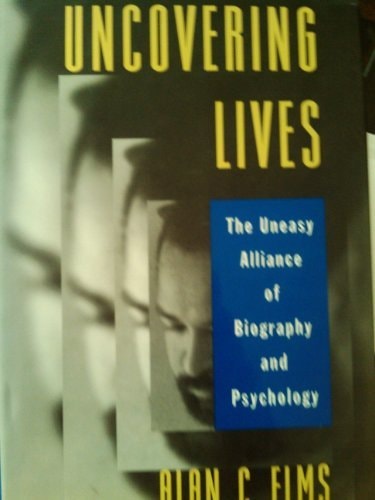
Uncovering Lives: The Uneasy Alliance of Biography and Psychology
0
0
As an Amazon Associate and affiliate partner, Menrva Books earns from qualifying purchases. Learn more
Author Description
Psychobiography is often attacked by critics who feel that it trivializes complex adult personalities, "explaining the large deeds of great individuals," as George Will wrote, "by some slight the individual suffered at a tender age--say, 7, when his mother took away a lollipop." Worse yet, some writers have clearly abused psychobiography--for instance, to grind axes from the right (Nancy Clinch on the Kennedy family) or from the left (Fawn Brodie on Richard Nixon)--and others have offered woefully inept diagnoses (such as Albert Goldman's portrait of Elvis Presley as a "split personality" and a "delusional paranoid"). And yet, as Alan Elms argues in Uncovering Lives, in the hands of a skilled practitioner, psychobiography can rival the very best traditional biography in the insights it offers.Elms makes a strong case for the value of psychobiography, arguing in large part from example. Indeed, most of the book features Elms's own fascinating case studies of over a dozen prominent figures, among them Sigmund Freud (the father of psychobiography), B.F. Skinner, Isaac Asimov, L. Frank Baum, Vladimir Nabokov, Jimmy Carter, George Bush, Saddam Hussein, and Henry Kissinger. These profiles make intriguing reading. For example, Elms discusses the fiction of Isaac Asimov in light of the latter's acrophobia (fear of heights) and mild agoraphobia (fear of open spaces)--and Elms includes excerpts from a series of letters between himself and Asimov. He reveals an unintended subtext of The Wizard of Oz--that males are weak, females are strong (think of Scarecrow, Tin Man, the Lion, and the Wizard, versus the good and bad witches and Dorothy herself)--and traces this in part to Baum's childhood heart disease, which kept him from strenuous activity, and to his relationship with his mother-in-law, Matilda Joslyn Gage, a distinguished advocate of women's rights. And in a fascinating chapter, he examines the abused childhood of Saddam Hussein, the privileged childhood of George Bush,
Menrva's Summary
THE THESIS
Can psychobiography provide genuine insight into the lives of historical figures without resorting to reductionist or biased interpretations? Alan C. Elms, a professor of psychology, argues that when practiced with rigor and nuance, psychobiography serves as a vital tool for understanding the complex motivations of prominent individuals. He addresses common criticisms regarding the field's tendency toward trivialization and political axe-grinding, proposing a framework that balances psychological theory with traditional biographical research.
THE SCOPE MAP
What You Will Find
- Case studies of over a dozen prominent figures including Sigmund Freud, B.F. Skinner, Isaac Asimov, and Saddam Hussein.
- Analysis of the intersection between personal phobias and creative output in literary figures.
- Examination of childhood development and its influence on adult political behavior and decision-making.
- Methodological guidelines for conducting ethical and evidence-based psychobiographical research.
THE AUTHORITY PERSPECTIVE
Experts and readers frequently note that Elms provides a balanced, scholarly defense of a controversial field. The text is widely regarded as a foundational resource for those interested in the intersection of psychological theory and historical narrative.
Page Count:
328
Publication Date:
1994-12-08
Publisher:
Oxford University Press
ISBN-10:
0195082877
ISBN-13:
9780195082876
Non-Fiction
Biography
History
Psychology
Biographical Methods
Literary Form
Politicians
Authors psychology
Psychologists
Literary Criticism
Community Tags
Similar Books