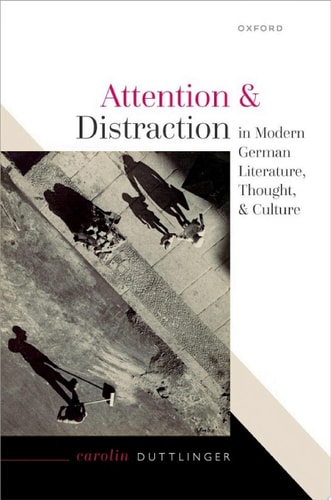
Attention and Distraction in Modern German Literature, Thought, and Culture
0
0
As an Amazon Associate and affiliate partner, Menrva Books earns from qualifying purchases. Learn more
Author Description
Attention is fundamental to how we experience reality, and yet this notion has been understood and practised in very different ways across history. This interdisciplinary study explores the dynamic relationship between attention and its supposed opposite, distraction, as it unfolds from the eighteenth century to the present day. Its primary focus is on twentieth-century Germany and Austria, where matters of (in)attention gained a unique urgency during a period of social change and political crisis. Building on Enlightenment practices of self-observation, nineteenth-century Germany was the birthplace of experimental psychology, a discipline which sought to measure and potentially enhance human attention. This approach was also adopted outside the psychological laboratory--for instance in the First World War, when psychological testing was used to select soldiers for particular strategic positions. After the war these techniques filtered through into everyday life. Weimar Germany was unique in the western world in rolling out the methods of 'psychotechnics' across civilian society--in fields such as work and education, advertising and mass entertainment. This state-sponsored programme aimed to reshape people's minds and behaviour in order to build a more efficient, streamlined society. But as this study shows, this initiative also had profound repercussions in the fields of thought, literature, and culture. New readings of leading writers and intellectuals of the period--Kafka, Musil, Kracauer, Benjamin, and Adorno--are interspersed with broader cultural-historical chapters dedicated to the history of psychology and psychiatry, to Weimar self-help literature, portrait photography, and musical culture.
Menrva's Summary
THE THESIS
This study investigates the shifting conceptualization of attention and distraction as fundamental mechanisms of human experience within the context of German and Austrian culture from the eighteenth century to the present. Prof. Carolin Duttlinger, a scholar of German literature and culture, utilizes a multidisciplinary framework that bridges experimental psychology, political history, and literary analysis. She argues that the twentieth-century German focus on 'psychotechnics' and mental efficiency significantly altered the intellectual landscape, forcing a re-evaluation of how writers and thinkers engaged with the modern world.
THE SCOPE MAP
What You Will Find
- Historical analysis of Enlightenment self-observation and the birth of experimental psychology.
- Examination of psychotechnics in Weimar-era work, education, and mass media.
- Critical readings of Kafka, Musil, Kracauer, Benjamin, and Adorno.
- Cultural history of portrait photography, self-help literature, and musical performance.
Scope Limits
- The study does not provide a comprehensive history of global psychological theory.
- It does not focus on non-Germanic cultural responses to the rise of mass media.
THE AUTHORITY PERSPECTIVE
Scholars frequently cite this work as a rigorous contribution to the intersection of intellectual history and literary theory. Experts highlight the author's ability to synthesize complex psychological data with nuanced close readings of canonical modernist texts.
Page Count:
455
Publication Date:
2022-01-01
Publisher:
OUP Oxford
ISBN-10:
0192669788
ISBN-13:
9780192669780
Politics
Philosophy
Psychology
Social Theory
Cultural History
Modernism
Literary Criticism
German Studies
Community Tags
Similar Books