Output Decline and Government Expenditures in European Transition Economies
0
0
As an Amazon Associate and affiliate partner, Menrva Books earns from qualifying purchases. Learn more
Author Description
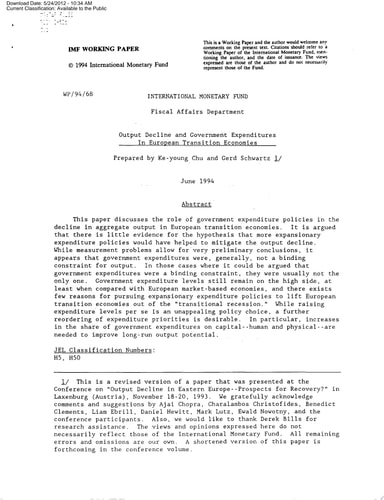
This paper discusses the role of government expenditure policies in the decline in aggregate output in European transition economies. It is argued that there is little evidence for the hypothesis that more expansionary expenditure policies would have helped to mitigate the output decline. While measurement problems allow for very preliminary conclusions, it appears that government expenditures were, generally, not a binding constraint for output. In those cases where it could be argued that government expenditures were a binding constraint, they were usually not the only one. Government expenditure levels still remain on the high side, at least when compared with European market-based economies, and there exists few reasons for pursuing expansionary expenditure policies to lift European transition economies out of the “transitional recession.” While raising expenditure levels per se is an unappealing policy choice, a further reordering of expenditure priorities is desirable. In particular, increases in the share of government expenditures on capital--human and physical--are needed to improve long-run output potential.
Menrva's Summary
THE THESIS
This paper investigates the relationship between government expenditure policies and the decline in aggregate output observed in European transition economies during the post-Soviet era. It is argued that expansionary government expenditure policies were unlikely to have mitigated the significant output decline experienced by these economies. The analysis suggests that government expenditures were generally not the primary binding constraint on output, although measurement issues limit definitive conclusions. While current expenditure levels remain high compared to established market economies, there is little justification for pursuing expansionary fiscal policies to overcome the transitional recession; instead, a strategic reordering of expenditure priorities, particularly an increased focus on human and physical capital investment, is recommended to foster long-term output potential.
THE SCOPE MAP
- Analysis of aggregate output decline in European transition economies.
- Examination of the role and impact of government expenditure policies.
- Evaluation of the hypothesis that expansionary expenditure policies could mitigate output decline.
- Discussion of measurement problems affecting conclusions.
- Comparison of government expenditure levels with European market-based economies.
- Assessment of the potential for expansionary expenditure policies to lift economies out of transitional recession.
- Recommendations for reordering expenditure priorities, with emphasis on capital investment (human and physical).
THE AUTHORITY PERSPECTIVE
This paper offers an economic analysis of the output decline in European transition economies, focusing on the efficacy of government expenditure policies. The authors present a nuanced argument that expansionary fiscal measures were unlikely to be the solution to the observed economic downturn. The study suggests that while government spending levels may still be high, the focus should shift from increasing overall expenditure to reallocating resources towards capital investment to enhance long-term economic potential.
Page Count:
34
Publication Date:
1994-06-01
Publisher:
International Monetary Fund
ISBN-10:
1451961065
ISBN-13:
9781451961065
Non-Fiction
Economics
Public Finance
Economic History
Community Tags
Similar Books