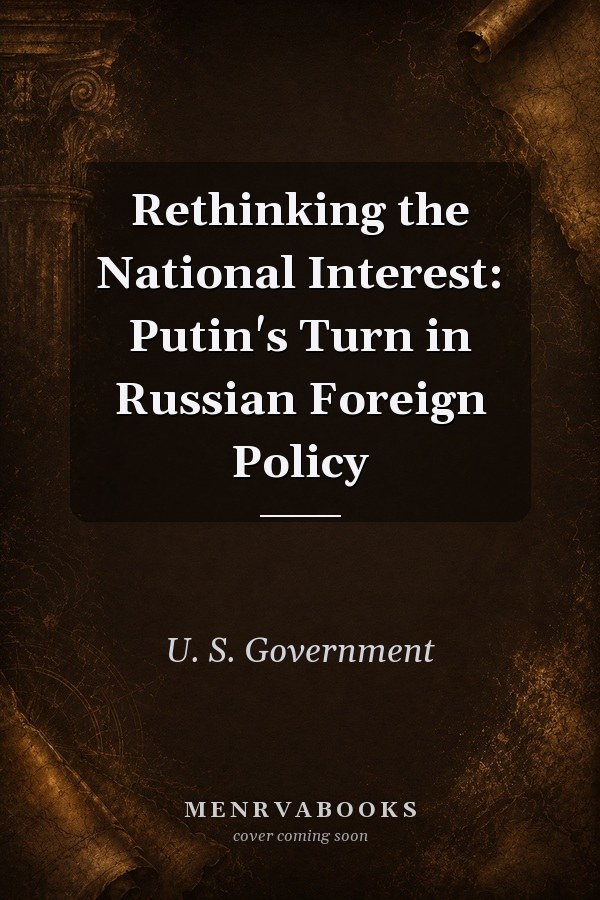
Rethinking the National Interest: Putin's Turn in Russian Foreign Policy
0
0
As an Amazon Associate and affiliate partner, Menrva Books earns from qualifying purchases. Learn more
Author Description
This paper examines the historical and political roots behind a turn in Russian foreign policy undertaken by President Vladimir Putin in the wake of the terrorist acts of 9/11. Current Russian foreign policy vastly differs from the previous decade in that, using the opportunity and the rhetoric of the war on terrorism, Putin made a normative choice in favor of Westernization and strategic partnership with the United States and Europe.The paper posits that the realignment in Russian foreign and security policy is of a long-term revolutionary nature. This is not an ad hoc marriage of convenience, nor a policy of playing a weaker hand, but a profound reappraisal of Russia's national interests and place in the world, defying the centuries-old imperial paradigms. In order to appreciate the magnitude of this change, the paper looks beyond the Putin presidency and transformations of the past decade, into the historical roots of Russian statehood and foreign policy. This Marshall Center Paper is an essay about foreign policy as explained by history, culture and geography.In this new strategic environment, Russia's singular global role has once again come to the fore and the state aligned itself closer to the Western security community. Russian President Vladimir Putin was the first foreign leader to express his condolences to President George W. Bush. This symbolic act forged a new strategic partnership that has endured over the past two years. Despite disagreements over the Iraqi war, the value of strategic partnership was reconfirmed at the Putin-Bush summit in May 2003. In a wider sense, President Putin has used the Global War on Terrorism (GWOT) as an opportunity to realign Russia with the West, pursuing the policy of Westernization both at home and abroad. This appears to be a deliberate, long-term policy-but what stands behind this transformation? What are the roots, philosophy and the practical reasoning behind Russia's new course? Marshall Center Paper No. 6, by Dr.
Menrva's Summary
THE THESIS
This paper investigates the historical and political underpinnings of Vladimir Putin's significant shift in Russian foreign policy following the 9/11 attacks. The analysis posits that this realignment, characterized by a normative choice favoring Westernization and strategic partnership with the US and Europe, represents a long-term, revolutionary transformation rather than a temporary alliance. It delves into the historical roots of Russian statehood and foreign policy, extending beyond the immediate post-Soviet decade to understand the profound reappraisal of Russia's national interests and global position, challenging centuries-old imperial paradigms.
THE SCOPE MAP
- Analysis of the historical and political roots of Putin's foreign policy shift.
- Examination of the impact of 9/11 and the rhetoric of the war on terrorism.
- Discussion of the normative choice for Westernization and strategic partnership with the US and Europe.
- Argument for the long-term, revolutionary nature of the realignment in Russian foreign and security policy.
- Exploration of Russia's national interests and place in the world, defying imperial paradigms.
- Contextualization within the broader history of Russian statehood and foreign policy.
- Consideration of the role of history, culture, and geography in shaping foreign policy.
- Highlighting Russia's alignment with the Western security community and Putin's early engagement with the US post-9/11.
THE AUTHORITY PERSPECTIVE
This paper, authored by entities associated with US government intelligence and security analysis, offers a strategic perspective on a pivotal moment in post-Soviet Russian foreign policy. The analysis emphasizes the depth and long-term implications of Putin's pivot towards the West, framing it as a fundamental redefinition of Russia's national interests. The work's origin suggests a focus on geopolitical strategy and the historical forces shaping international relations, likely intended for an audience engaged with security studies and international affairs.
Page Count:
169
Publication Date:
2017-11-18
Publisher:
Independently Published
ISBN-10:
1973327163
ISBN-13:
9781973327165
Non-Fiction
History
Foreign Policy
Russian History
Geopolitics
Community Tags
Similar Books


Reader Comments
Share Your Thoughts
No comments yet. Be the first to share your thoughts!