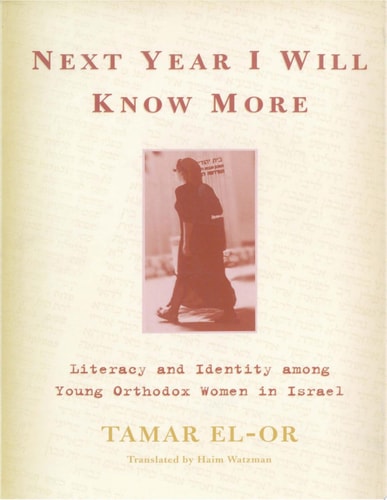
Next Year I Will Know More: Literacy and Identity among Young Orthodox Women in Israel
0
0
As an Amazon Associate and affiliate partner, Menrva Books earns from qualifying purchases. Learn more
Author Description
In traditional Jewish societies of previous centuries, literacy education was mostly a male prerogative. Even more recently, women have not been taught the traditional male curriculum that includes the Talmud and midrashic books. But the situation is changing, partly because of the special emphasis that modern Judaism places on learning its philosophy and traditions and on broadening its circle of knowers. In Next Year I Will Know More, the distinguished Israeli anthropologist Tamar El-Or explores the spreading practice of intensive Judaic studies among women in the religious Zionist community. Feminist literacy, notes El-Or, will alter gender relations and the construction of gender identities of the members of the religious community. This in turn could effect changes in Jewish theology and law. In an engaging narrative that offers rare insights into a traditional society in the midst of a modern world, the author points to a community that will be more feminist—and even more religious.
Menrva's Summary
THE THESIS
This book investigates the evolving landscape of literacy and identity among young Orthodox women in Israel. The author, Tamar El-Or, an esteemed Israeli anthropologist, examines the increasing engagement of women in intensive Judaic studies within the religious Zionist community. This shift, driven by modern Judaism's emphasis on learning and tradition, challenges historical norms where literacy was primarily a male domain. El-Or posits that this growing feminist literacy will reshape gender relations and identities, potentially influencing Jewish theology and law.
THE SCOPE MAP
- Exploration of intensive Judaic studies among women in the religious Zionist community.
- Analysis of how increased literacy impacts gender relations and identity construction.
- Discussion of the potential effects on Jewish theology and law.
- Insights into a traditional society navigating modern influences.
- Focus on the intersection of feminism and religious observance.
- Examination of the changing role of women in religious scholarship.
THE AUTHORITY PERSPECTIVE
The book offers a nuanced perspective on the dynamic interplay between tradition and modernity within the religious Zionist community in Israel. It highlights the transformative power of education, particularly for women, in reshaping religious and social landscapes. The work is noted for providing rare insights into a community undergoing significant internal change, suggesting a future where religious observance and feminist principles can coexist and even strengthen each other. This anthropological study is recognized for its engaging narrative and its forward-looking analysis of evolving gender roles within a deeply religious context.
Page Count:
336
Publication Date:
2002-05-01
Publisher:
Wayne State University Press
ISBN-10:
0814337783
ISBN-13:
9780814337783
Non-Fiction
History
Religion
Jewish Studies
Anthropology
Sociology
Gender Studies
Community Tags
Similar Books














