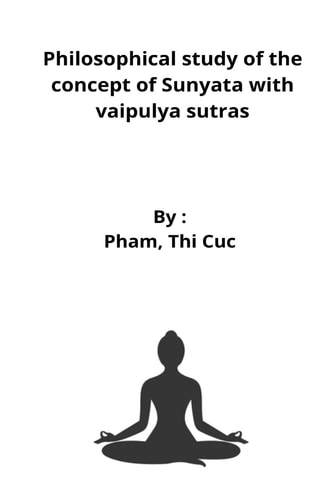
Philosophical Study of the Concept of Sunyata with Vaipulya Sutras
0
0
As an Amazon Associate and affiliate partner, Menrva Books earns from qualifying purchases. Learn more
Author Description
INTRODUCTION 1. THE PURPOSE OF THE PRESENT STUDY If we glimpse at the history of Indian philosophy, we see that almost every school of Indian philosophy has made an attempt to solve the problems of human being that come to his private as well as social life. Buddhism is not an exception to this. Gautama Buddha, the founder of Buddhism also has made an attempt to solve the problem of suffering that comes to human life. While solving the problem of suffering, he has advocated that Trsnd or uncontrolled and unlimited desire of man is the basic cause of suffering. According to the Buddha, man himself is responsible for suffering as well as responsible for the cessation of suffering. He has further advocated that if an individual has valid knowledge, he can eradicate the Trsnd and thereby makes himself free from suffering. This thought of the Buddha presupposes four things: 1) Human nature; 2) Nature of the external world; 3) Individual's knowledge about himself,
Menrva's Summary
THE THESIS
This study investigates the concept of Sunyata (emptiness) within the Mahayana Buddhist tradition, specifically through the lens of the Vaipulya Sutras. The author, Pham Thi Cuc, draws upon the foundational teachings of Buddhism, which identify uncontrolled desire as the root cause of suffering. The work posits that through valid knowledge and self-understanding, individuals can achieve liberation from suffering, exploring the nature of human existence, the external world, and individual consciousness as integral to this process.
THE SCOPE MAP
- An examination of the concept of Sunyata (emptiness) in Mahayana Buddhism.
- Analysis of the Vaipulya Sutras as primary textual sources.
- Exploration of the Buddhist understanding of suffering and its cessation.
- Discussion on the role of desire (Trsnd) as the cause of suffering.
- Consideration of the importance of valid knowledge for spiritual liberation.
- An inquiry into human nature and the external world within Buddhist philosophy.
THE AUTHORITY PERSPECTIVE
This work appears to be a scholarly exploration of core Buddhist philosophical concepts, likely aimed at students or practitioners of Buddhism and philosophy. The detailed examination of Sunyata and the Vaipulya Sutras suggests a text that delves into complex theological and philosophical arguments. Its focus on suffering and liberation indicates a traditional Buddhist approach to understanding the human condition.
Page Count:
182
Publication Date:
2022-04-28
Publisher:
Ahmed
ISBN-10:
7097868325
ISBN-13:
9787097868324
Philosophy
Non-Fiction
Indian philosophy
Buddhism
Community Tags
Similar Books