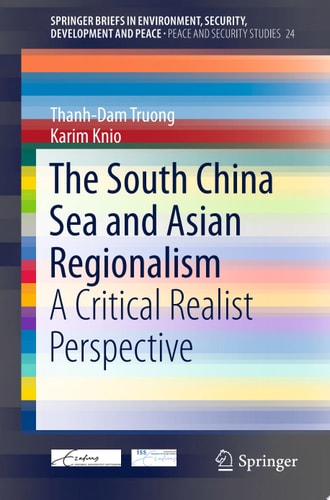
The South China Sea and Asian Regionalism
0
0
As an Amazon Associate and affiliate partner, Menrva Books earns from qualifying purchases. Learn more
Author Description
This book offers an innovative approach to the analysis of the current crisis in the South China Sea. Moving beyond the spirit of the UN Convention on the Law of the Sea (UNCLOS), the mechanisms of which are limited to physical geography, it demonstrates how epistemological insights from the field of critical realist philosophy can reveal the importance of cultural and structural conditioning processes in social interactions, processes which shape the conditions for the emergence of crisis points along a spectrum of conflict and cooperation. The potential for conflict resolution and the emergence of new regions in Pacific Asia much depends on the nature of such interactions at many levels (political-economic, semiotic and cultural) based on perceptions of what constitutes the "common" versus a Sinicised version of "Lebensraum".
Menrva's Summary
THE THESIS
This book investigates the complex crisis in the South China Sea by applying critical realist philosophy to understand its underlying cultural and structural conditioning processes. Moving beyond the limitations of the UN Convention on the Law of the Sea (UNCLOS), which focuses primarily on physical geography, the authors demonstrate how epistemological insights can illuminate the social interactions that foster conflict and cooperation. The analysis explores how perceptions of the
THE SCOPE MAP
- Application of critical realist philosophy to international relations and geopolitical crises.
- Analysis of the South China Sea crisis, moving beyond traditional legal frameworks like UNCLOS.
- Exploration of cultural and structural conditioning processes in social interactions.
- Examination of the spectrum of conflict and cooperation in the region.
- Discussion of perceptions of the "common" versus a Sinicised version of "Lebensraum".
- Insights into the potential for conflict resolution and the emergence of new regions in Pacific Asia.
THE AUTHORITY PERSPECTIVE
The book offers an innovative philosophical approach to understanding the South China Sea crisis, suggesting that cultural and structural conditioning processes are crucial to social interactions and the emergence of conflict points. It posits that conflict resolution and regional emergence in Pacific Asia are contingent upon how interactions are perceived, particularly concerning the distinction between the "common" and a Sinicised "Lebensraum". The work aims to reveal the importance of these deeper social dynamics, which are often overlooked by purely geographical or legal analyses.
Page Count:
105
Publication Date:
2016-01-15
Publisher:
Springer Nature
ISBN-10:
3319135511
ISBN-13:
9783319135519
Non-Fiction
Philosophy
Politics
Geopolitics
Law
International relations
Asian Studies
Community Tags
Similar Books