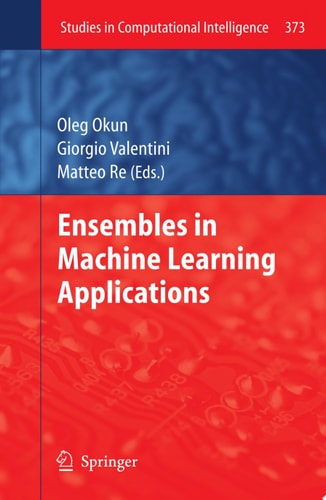
Ensembles in Machine Learning Applications
0
0
As an Amazon Associate and affiliate partner, Menrva Books earns from qualifying purchases. Learn more
Author Description
This book contains the extended papers presented at the 3rd Workshop on Supervised and Unsupervised Ensemble Methods and their Applications (SUEMA) that was held in conjunction with the European Conference on Machine Learning and Principles and Practice of Knowledge Discovery in Databases (ECML/PKDD 2010, Barcelona, Catalonia, Spain). As its two predecessors, its main theme was ensembles of supervised and unsupervised algorithms – advanced machine learning and data mining technique. Unlike a single classification or clustering algorithm, an ensemble is a group of algorithms, each of which first independently solves the task at hand by assigning a class or cluster label (voting) to instances in a dataset and after that all votes are combined together to produce the final class or cluster membership. As a result, ensembles often outperform best single algorithms in many real-world problems. This book consists of 14 chapters, each of which can be read independently of the others. In addition to two previous SUEMA editions, also published by Springer, many chapters in the current book include pseudo code and/or programming code of the algorithms described in them. This was done in order to facilitate ensemble adoption in practice and to help to both researchers and engineers developing ensemble applications.
Menrva's Summary
THE THESIS
This book investigates the application and implementation of ensemble methods in machine learning and data mining. It presents extended papers from the 3rd Workshop on Supervised and Unsupervised Ensemble Methods and their Applications (SUEMA), focusing on the advanced technique of combining multiple algorithms to improve predictive accuracy. The book details how ensembles, by aggregating the outputs of individual algorithms, often surpass the performance of single models in real-world scenarios. It is structured into 14 independent chapters, many of which include pseudocode and programming examples to aid practical adoption by researchers and engineers.
THE SCOPE MAP
- Extended papers from the SUEMA workshop held at ECML/PKDD 2010.
- Detailed exploration of supervised and unsupervised ensemble methods.
- Explanation of ensemble techniques, including voting mechanisms for classification and clustering.
- Discussions on how ensembles outperform single algorithms in practical applications.
- 14 independently readable chapters.
- Inclusion of pseudocode and programming code for algorithms to facilitate practical use.
THE AUTHORITY PERSPECTIVE
This collection of papers offers a deep dive into ensemble methods, a critical area of machine learning. The inclusion of practical code examples suggests a focus on applicability for both academic researchers and industry practitioners. The book's origin from a specialized workshop indicates a targeted audience interested in the latest advancements in supervised and unsupervised ensemble techniques.
Page Count:
252
Publication Date:
2011-09-01
Publisher:
Springer Nature
ISBN-10:
3642229107
ISBN-13:
9783642229107
Science
Non-Fiction
Computer Science
Algorithms
Data Mining
Machine Learning
Community Tags
Similar Books