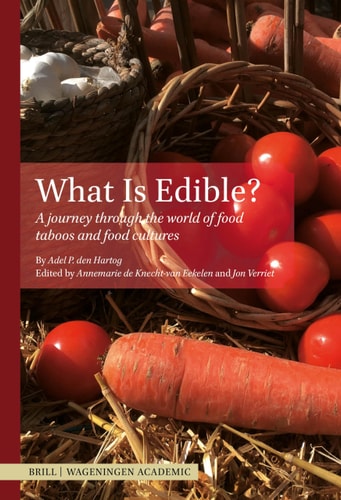
What is Edible? A Journey Through the World of Food Taboos and Food Cultures
0
0
As an Amazon Associate and affiliate partner, Menrva Books earns from qualifying purchases. Learn more
Author Description
Adel den Hartog shows how complex the food choices of humans have been for millenia. Those who wonder why we eat what we eat, will find out practicalities, such as availability of products, transportation and costs, but also physiological, cultural, geological, and psychological factors matter. Den Hartog points out the importance of access to food for individuals and groups, and the influence of their socio-economical position. Can someone be convinced to eat something that they perceive as inedible? This book gives many examples of our limited flexibility, whether caused by an intolerance for genetical reasons, or because we simply did not know the food and want to keep it that way. Food habits are slow to respond to interventions, but these days, a meatless meal is no longer a sign of poverty. The book will attract the culturally interested reader. It can be used as a handbook for those who want to understand the background of our eating habits. The knowledge in this book can be used for a large range of interventions when it comes to food and life style.
Menrva's Summary
THE THESIS
This book investigates the complex interplay of factors that shape human food choices and the prevalence of food taboos across cultures and throughout history. Adel den Hartog, drawing on his expertise, explores how practical considerations like product availability, transportation, and cost intersect with physiological, cultural, geological, and psychological influences to determine what humans deem edible. The work emphasizes the critical role of food access and its connection to an individual's or group's socio-economic standing, questioning our inherent flexibility when faced with perceived inedible substances, whether due to genetic intolerance or unfamiliarity. It highlights the slow pace of change in food habits, noting shifts such as the modern perception of meatless meals no longer signifying poverty.
THE SCOPE MAP
- Analysis of practical factors influencing food choices: availability, transportation, and cost.
- Exploration of physiological, cultural, geological, and psychological determinants of edibility.
- Examination of the importance of food access for individuals and groups, and its relation to socio-economic position.
- Discussion of human flexibility and resistance to consuming perceived inedible items.
- Case studies illustrating food taboos and cultural food practices.
- The historical evolution of food habits and their resistance to intervention.
- Insights into the changing social significance of dietary choices, such as meat consumption.
THE AUTHORITY PERSPECTIVE
The book is positioned as a valuable resource for culturally interested readers seeking to understand the underlying reasons for human eating habits. It is presented as a potential handbook for comprehending the background of our dietary practices. The knowledge contained within is suggested to be applicable to a wide range of interventions related to food and lifestyle choices. The work aims to provide a comprehensive overview of the multifaceted nature of food selection and cultural norms surrounding consumption.
Page Count:
111
Publication Date:
2024-01-01
Publisher:
Brill, Wageningen Academic
ISBN-10:
9004694315
ISBN-13:
9789004694316
Non-Fiction
History
Science
Food Studies
Cultural Anthropology
Sociology
Community Tags
Similar Books