Vedic Voices: Intimate Narratives of a Living Andhra Tradition
0
0
As an Amazon Associate and affiliate partner, Menrva Books earns from qualifying purchases. Learn more
Author Description
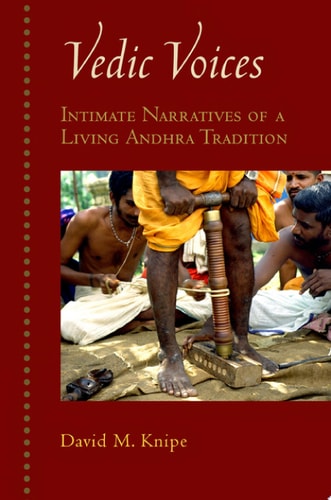
For countless generations families have lived in isolated communities in the Godavari Delta of coastal Andhra Pradesh, learning and reciting their legacy of Vedas, performing daily offerings and occasional sacrifices. They are the virtually unrecognized survivors of a 3,700-year-old heritage, the last in India who perform the ancient animal and soma sacrifices according to Vedic tradition. In Vedic Voices, David M. Knipe offers for the first time, an opportunity for them to speak about their lives, ancestral lineages, personal choices as pandits, wives, children, and ways of coping with an avalanche of changes in modern India. He presents a study of four generations of ten families, from those born at the outset of the twentieth century down to their great-grandsons who are just beginning, at the age of seven, the task of memorizing their Veda, the Taittiriya Samhita, a feat that will require eight to twelve years of daily recitations. After successful examinations these young men will reside with the Veda family girls they married as children years before, take their places in the oral transmission of a three-thousand-year Vedic heritage, teach the Taittiriya collection of texts to their own sons, and undertake with their wives the major and minor sacrifices performed by their ancestors for some three millennia.Coastal Andhra, famed for bountiful rice and coconut plantations, has received scant attention from historians of religion and anthropologists despite a wealth of cultural traditions. Vedic Voices describes in captivating prose the geography, cultural history, pilgrimage traditions, and celebrated persons of the region. Here unfolds a remarkable story of Vedic pandits and their wives, one scarcely known in India and not at all to the outside world.
Menrva's Summary
THE THESIS
This work investigates the survival and lived experience of the last remaining practitioners of ancient Vedic animal and soma sacrifices within the Godavari Delta of Andhra Pradesh. David M. Knipe, an expert in the history of religions, utilizes extensive ethnographic fieldwork and personal interviews to document the lives of ten families across four generations. He argues that these individuals maintain a 3,700-year-old oral tradition while navigating the pressures of contemporary Indian society and modernization.
THE SCOPE MAP
What You Will Find
- Longitudinal study of four generations of ten Vedic pandit families.
- Detailed accounts of the Taittiriya Samhita oral transmission process.
- Cultural and geographical history of the Godavari Delta region.
- Primary source interviews with pandits, wives, and children regarding their ancestral roles.
Scope Limits
- The text focuses specifically on the coastal Andhra tradition and does not provide a comprehensive survey of all Vedic practices across India.
- It does not attempt to provide a theological analysis of the Vedic texts themselves, focusing instead on the human practitioners.
THE AUTHORITY PERSPECTIVE
Scholars and anthropologists recognize this text as a rare, primary-source documentation of a vanishing religious practice. Readers frequently note the depth of the ethnographic detail and the author's success in humanizing a tradition often viewed only through abstract historical lenses.
Page Count:
368
Publication Date:
2015-01-01
Publisher:
Oxford University Press
ISBN-10:
0190266732
ISBN-13:
9780190266738
History
Religion
Brahmans
India religion
Sociology
Cultural Anthropology
Asian History
Anthropology
India
Vedic Studies
Cultural History
Community Tags
Similar Books