
Efficient Data Input/Output (I/O) for Finite Difference Time Domain (FDTD) Computation on Graphics Processing Unit (GPU)
0
0
As an Amazon Associate and affiliate partner, Menrva Books earns from qualifying purchases. Learn more
Author Description
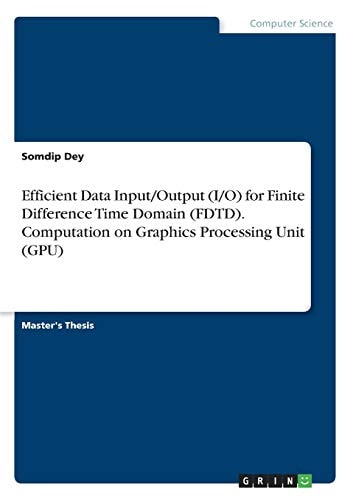
Master's Thesis from the year 2014 in the subject Computer Science - Applied, grade: First, University of Manchester (School of Computer Science), course: Advanced Computer Science: Computer Systems Engineering, language: English, abstract: Due to recent advancement in technology, one of the popular ways of achieving performance with respect to execution time of programs is by utilizing massive parallelism power of GPU-based accelerator computing along with CPU computing. In GPU- based accelerator computing, the data intensive or computationally intensive part is computed on the GPU whereas the simple yet complex instructions are computed on the CPU in order to achieve massive speedup in execution time of the computer program executed on the computer system. In physics, especially in electromagnetism, Finite-Difference Time-Domain (FDTD) is a popular numerical analysis method, which is used to solve the set of Maxwells partial differential equations to unify and relate electric field with magnetic field. Since FDTD method is computationally intensive and has high level of parallelism in the computational implementation, for this reason for past few years researchers are trying to compute the computationally intensive part of FDTD methods on the GPU instead of CPU. Although computing parallelized parts of FDTD algorithms on the GPU achieve very good performance, but fail to gain very good speedup in execution time because of the very high latency between the CPU and GPU. Calculation results at each FDTD time-step is supposed to be produced and saved on the hard disk of the system. This can be called as data output of the FDTD methods, and the overlapping of data output and computation of the field values at next time step cannot be performed simultaneously. Because of this and latency gap between the CPU and GPU, there is a bottleneck in the performance of the data output of the GPU. This problem can be regarded as the inefficient performance of data input/output (I/
Menrva's Summary
THE THESIS
This thesis investigates the performance bottleneck in data input/output (I/O) for Finite Difference Time Domain (FDTD) computations accelerated by Graphics Processing Units (GPUs). The work addresses the challenge of achieving significant speedups in FDTD simulations when data output and subsequent computation steps are not effectively overlapped due to high CPU-GPU latency. The author explores how this inefficiency impacts the overall performance of computationally intensive FDTD methods, particularly in the field of electromagnetism, where Maxwell's equations are solved numerically.
THE SCOPE MAP
- Analysis of GPU-based accelerator computing for performance enhancement.
- Explanation of the Finite-Difference Time-Domain (FDTD) method for solving Maxwell's equations.
- Identification of the performance bottleneck caused by high CPU-GPU latency in FDTD computations.
- Discussion of the challenges in overlapping data output with computation at each time-step.
- Exploration of strategies to improve data I/O performance for GPU-accelerated FDTD.
- Focus on electromagnetism applications of FDTD methods.
THE AUTHORITY PERSPECTIVE
This Master's thesis, originating from the University of Manchester, focuses on a specific technical challenge within computational physics and computer science. The work addresses the inefficiencies in data input/output for GPU-accelerated Finite Difference Time Domain (FDTD) methods, a critical area for performance gains in electromagnetic simulations. The research highlights the latency gap between CPUs and GPUs as a primary obstacle to achieving full computational speedup. The thesis aims to provide insights into optimizing these data-intensive processes for better execution times.
Page Count:
107
Publication Date:
2019-05-17
Publisher:
GRIN Verlag
ISBN-10:
3668939543
ISBN-13:
9783668939547
Science
Non-Fiction
Computer Science
Community Tags
Other Editions(2)
Similar Books












Reader Comments
Share Your Thoughts
No comments yet. Be the first to share your thoughts!