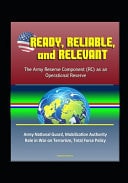
Ready, Reliable, and Relevant: The Army Reserve Component (RC) as an Operational Reserve - Army National Guard, Mobilization Authority, Role in War on Terrorism, Total Force Policy
0
0
As an Amazon Associate and affiliate partner, Menrva Books earns from qualifying purchases. Learn more
Author Description
The Army Reserve Component (RC) has a major role in America's Global War on Terror (GWOT). Over the past decade and a half, the Army National Guard (ARNG) and the United States Army Reserve (USAR) have mobilized hundreds of thousands of Soldiers in support of contingency operations in Iraq and Afghanistan, as well as to numerous other missions worldwide and throughout the Continental United States (CONUS). They have proven their capabilities and exceeded operational expectations, successfully transitioning from the strategic reserve force of the Cold War era to a well-trained and experienced operational reserve force of the GWOT era. The problem facing the Department of Defense (DOD), is determining the future utilization of RC forces, specifically their operational role, their implementation, and the development of a suitable mobilization authority that will support a broad spectrum of future operational requirements. This monograph presents two primary arguments. First, the Army RC should continue its role as an operational reserve in support of future operational requirements. Second, continuing the use of the Army RC as an operational reserve requires the implementation of a new mobilization authority, one that will be more lasting, functional, and suitable for the current operating environment. This monograph presents two key proposals including the sustainment of the RC as an operational reserve, and a comprehensive plan for the implementation of a new mobilization authority. The action plan for these proposals includes a recommended framework and guidelines for a new mobilization authority that will achieve the goals of maintaining the use of RC forces as an operational reserve while modernizing the mobilization process to meet the demands of the current operating environment. A new and improved mobilization authority will allow Army RC forces to remain ready, reliable and relevant, capable of supporting future operational requirements of the 21st century. Th
Menrva's Summary
THE THESIS
The U.S. Army Reserve Component (RC) has evolved from a Cold War strategic reserve to a critical operational force in the Global War on Terror (GWOT), but faces challenges in defining its future utilization and mobilization authority. The Department of Defense must determine how to best employ RC forces, specifically their operational role and implementation, and develop a suitable mobilization authority for future requirements. This monograph argues for the continued use of the RC as an operational reserve and proposes a new, more functional mobilization authority to meet the demands of the current operating environment. It outlines a comprehensive plan for implementing this new authority to ensure RC forces remain ready, reliable, and relevant for 21st-century operational needs.
THE SCOPE MAP
- Analysis of the Army Reserve Component's (RC) role in the Global War on Terror (GWOT).
- Examination of the mobilization of Army National Guard (ARNG) and United States Army Reserve (USAR) Soldiers.
- Discussion of the transition from a strategic reserve to an operational reserve force.
- Identification of challenges in determining future RC utilization and operational roles.
- Proposal for a new, lasting, and functional mobilization authority.
- A comprehensive plan for implementing the proposed mobilization authority.
- Recommended framework and guidelines for the new mobilization authority.
THE AUTHORITY PERSPECTIVE
This monograph presents a clear thesis on the evolving role of the Army Reserve Component (RC) and the necessity for a modernized mobilization authority. The analysis focuses on the practical experiences of the RC in recent conflicts, particularly the GWOT, and extrapolates these to future operational requirements. The proposed framework for a new mobilization authority aims to ensure the RC's continued readiness and relevance in a dynamic global security landscape. The work is positioned as a policy recommendation for the Department of Defense.
Page Count:
88
Publication Date:
2017-03-03
Publisher:
Amazon Digital Services LLC - KDP Print US
ISBN-10:
1520753845
ISBN-13:
9781520753843
Non-Fiction
Politics
History
Government Policy
National security
Military History
Community Tags
Similar Books






Reader Comments
Share Your Thoughts
No comments yet. Be the first to share your thoughts!