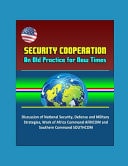
Security Cooperation: An Old Practice for New Times - Discussion of National Security, Defense and Military Strategies, Work of Africa Command AFRICOM and Southern Command SOUTHCOM
0
0
As an Amazon Associate and affiliate partner, Menrva Books earns from qualifying purchases. Learn more
Author Description
This monograph addresses the current security cooperation structures within the context of recent strategic guidance. This guidance calls for a whole-of-government approach to build partner capacity. Much of the current security cooperation structure, organization, and funding authorities developed over the course of the Cold War, however, and focused on building the defense capability of allies and security partners against the threat of Soviet expansion. The current strategic environment, in contrast to the Cold War era, includes threats from transnational and subnational actors. Terrorism and insurgency have moved from the periphery to the forefront of security concerns. This monograph examines two case studies at the geographic combatant command level to evaluate their organizational structure and interagency processes within this new context. The monograph then examines the new DOD funding authority, Section 1206, to determine its utility as a model for future security cooperation funding initiatives. This monograph finds that the requirements for Department of State and Department of Defense collaboration under Section 1206 foster the type of interagency cooperation advocated in recent strategic guidance. ACRONYMS * INTRODUCTION * DEVELOPMENT OF THE SECURITY COOPERATION STRUCTURE * Origins of U.S. Security Cooperation * Evolution of Security Cooperation * Current Security Cooperation Structure * Challenges * STRATEGIC GUIDANCE * National Security Strategy (NSS) 2011 * National Defense Strategy (NDS) 2008 * National Military Strategy (NMS) 2011 * Defense Strategic Guidance (2012) * Defense Budget Priorities (2012). * Quadrennial Diplomacy and Development Review (QDDR) (2010) * CASE STUDIES * AFRICOM * SOUTHCOM * AFRICOM and SOUTHCOM Compared * SECTION 1206 * 1206 Background * 1206 Implementation * Assessment * CONCLUSION * BIBLIOGRAPHY * FOOTNOTES
Menrva's Summary
THE THESIS
This monograph investigates the evolution and current effectiveness of U.S. security cooperation structures in light of contemporary strategic guidance and emerging threats. The work examines how structures developed during the Cold War, primarily focused on countering Soviet expansion, fare against modern challenges posed by transnational and subnational actors, terrorism, and insurgency. It analyzes two case studies, Africa Command (AFRICOM) and Southern Command (SOUTHCOM), to assess their organizational frameworks and interagency processes. Furthermore, the monograph evaluates the utility of Section 1206 funding authority as a model for future security cooperation initiatives, finding that its collaborative requirements foster the interagency cooperation advocated in recent strategic documents.
THE SCOPE MAP
- Analysis of current security cooperation structures within the context of recent strategic guidance.
- Examination of the historical development of U.S. security cooperation, tracing its origins to the Cold War.
- Discussion of challenges faced by current security cooperation frameworks in addressing modern threats.
- Review of key strategic documents including the National Security Strategy (NSS) 2011, National Defense Strategy (NDS) 2008, and National Military Strategy (NMS) 2011.
- In-depth case studies of Africa Command (AFRICOM) and Southern Command (SOUTHCOM).
- Comparative analysis of AFRICOM and SOUTHCOM organizational structures and interagency processes.
- Evaluation of the Department of Defense (DoD) funding authority, Section 1206, for building partner capacity.
- Assessment of Section 1206's implementation and its potential as a model for future funding initiatives.
THE AUTHORITY PERSPECTIVE
This monograph is presented as an analytical examination of U.S. security cooperation, focusing on its historical context and adaptation to modern strategic environments. The work is structured to provide a comprehensive overview, beginning with the evolution of security cooperation frameworks and moving into specific case studies and funding mechanisms. The analysis aims to inform discussions on national security, defense, and military strategies by evaluating the effectiveness of existing structures and proposing insights for future initiatives. The inclusion of detailed case studies and a review of specific legislative authorities suggests a focus on practical application and policy relevance.
Page Count:
65
Publication Date:
2018-05-19
Publisher:
Amazon Digital Services LLC - KDP Print US
ISBN-10:
1982938749
ISBN-13:
9781982938741
History
Non-Fiction
Politics
National security
Foreign Policy
Military Strategy
International relations
Government
Geopolitics
Community Tags
Similar Books











Reader Comments
Share Your Thoughts
No comments yet. Be the first to share your thoughts!