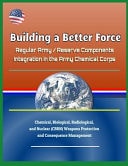
Building a Better Force: Regular Army / Reserve Components Integration in the Army Chemical Corps - Chemical, Biological, Radiological, and Nuclear (CBRN) Weapons Protection and Consequence Management
0
0
As an Amazon Associate and affiliate partner, Menrva Books earns from qualifying purchases. Learn more
Author Description
Over the past twenty years, the mission of the Army Chemical Corps has evolved from a focus on protecting military forces against Chemical, Biological, Radiological, and Nuclear (CBRN) weapons to include the elimination Weapons of Mass Destruction (WMD), and CBRN consequence management. At the same time, an increased focus by both adversary state and non-state actors on acquiring WMD has increased the potential for their use. Due to both increasing mission requirements and emerging threats, the Army must seek to implement policies and systems that provide a Chemical Force capable of responding to the full range of CBRN threats and hazards. With more than eighty percent of the Chemical Force residing in the Reserve Components (RCs), it is necessary to integrate the total force to optimize Chemical Force effectiveness. Integration has been challenged by the implementation of statutes and policies that have erected institutional barriers between the Regular Army (RA) and RCs. This paper analyzes potential challenges and identifies opportunities for increasing the responsiveness and effectiveness of the Army Chemical Corps through RA / RCs integration.1. Introduction * 2. The Transformation Discourse: A Capabilities Based Discussion, But is it Enough? * 3. The Unholy Trinity: The Contemporary Chemical Force and the Force of Change * 4. Three Teams, One Fight: Institutional Barriers to Total Force Integration * 5. Changing the Army's Culture: Moving Toward a Single Force Policy * 6. ConclusionThe challenges facing the Army for RA and RCs integration directly relate to institutional barriers erected over the past twenty-five years. While the Army National Guard (ANG) and Army Reserve (USAR) were initially established in the early 20th century to provide an accessible federal reserve force, over time, changes in the structure of, and relationships between, the RA and RCs have decreased their integration as a single force. The Total Force policy and Abrams doctrine adopted
Menrva's Summary
THE THESIS
The U.S. Army Chemical Corps faces a critical challenge in integrating its Regular Army (RA) and Reserve Components (RCs) to effectively counter evolving Chemical, Biological, Radiological, and Nuclear (CBRN) threats. The Corps' mission has expanded beyond protection to include WMD elimination and consequence management, driven by increased adversary capabilities. This paper analyzes the institutional barriers that have historically hindered RA/RC integration and explores opportunities to optimize the Chemical Force's responsiveness and effectiveness by fostering a unified approach to the full spectrum of CBRN hazards.
THE SCOPE MAP
- Analysis of the evolution of the Army Chemical Corps' mission over the past twenty years.
- Discussion of the increasing threat posed by state and non-state actors acquiring WMD.
- Examination of the current structure and capabilities of the Chemical Force, with over eighty percent residing in Reserve Components.
- Identification of institutional barriers and policy implementations that have created divisions between the Regular Army and Reserve Components.
- Exploration of opportunities for increasing the responsiveness and effectiveness of the Army Chemical Corps through RA/RC integration.
- Review of the historical context of the Army National Guard and Army Reserve establishment and their evolving relationship with the Regular Army.
- Discussion of the 'Total Force' policy and 'Abrams doctrine' in the context of RA/RC integration.
THE AUTHORITY PERSPECTIVE
This analysis, authored by individuals associated with the Department of Defense, delves into the strategic imperative of integrating the U.S. Army's Regular Army and Reserve Components within the Chemical Corps. The work systematically examines the historical development of the Corps' mission and the contemporary threat landscape, highlighting the necessity for a cohesive force structure. It identifies specific institutional barriers that impede seamless integration and proposes pathways toward optimizing the effectiveness of the entire Chemical Force in managing CBRN threats and WMD consequences. The paper's focus on policy and cultural shifts suggests an intended audience of military strategists, policymakers, and defense analysts.
Page Count:
80
Publication Date:
2018-10-20
Publisher:
Amazon Digital Services LLC - KDP Print US
ISBN-10:
1729015336
ISBN-13:
9781729015339
Non-Fiction
History
Defense
Government Policy
Military History
National security
Community Tags
Similar Books





Reader Comments
Share Your Thoughts
No comments yet. Be the first to share your thoughts!