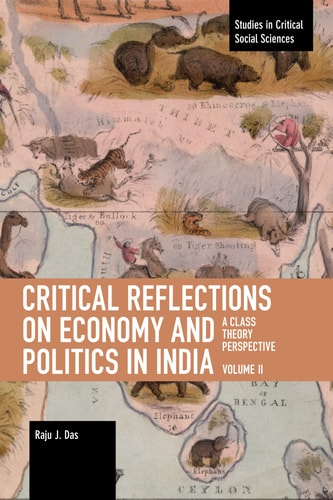
Critical Reflections on Economy and Politics in India: Volume 2: A Class Theory Perspective
0
0
As an Amazon Associate and affiliate partner, Menrva Books earns from qualifying purchases. Learn more
Author Description
In the first volume of this sweeping analysis of contemporary India, Raju Das offers a much needed class-based perspective on the economic situation in what has become one of the fastest growing economies in the world. Offering invaluable insights along the way, Das examines the specificities of Indian capitalism and neoliberalism, the country's geographically uneven development, the impact of technological change, and the consequences of its export-oriented, nature-dependent production. Critical Reflections on Economy and Politics in India applies abstract theoretical ideas to the concrete situation in India, which, in turn, inspires a rethinking of theory. Das unabashedly shows the relevance of a class theory that takes seriously matters of oppression/domination of religious minorities and lower castes. A must read for anyone looking to not only interpret the world, but to change it.
Menrva's Summary
THE THESIS
This book critically examines the economic and political landscape of contemporary India through the lens of class theory. Raju Das, drawing on his extensive background in analyzing global capitalism, applies abstract theoretical concepts to the specific context of India, a rapidly growing economy grappling with neoliberal policies. The analysis delves into the unique characteristics of Indian capitalism, its uneven development, the effects of technological shifts, and the implications of its production models. Furthermore, the work highlights the significance of class theory in understanding oppression related to religious minorities and lower castes, aiming to both interpret and instigate change.
THE SCOPE MAP
- Analysis of contemporary Indian capitalism and neoliberalism.
- Examination of India's geographically uneven development.
- Impact of technological change on the Indian economy.
- Consequences of India's export-oriented, nature-dependent production.
- Application of abstract theoretical ideas to the concrete Indian situation.
- Exploration of oppression and domination of religious minorities and lower castes.
- Relevance of class theory for understanding social and economic structures.
THE AUTHORITY PERSPECTIVE
The book is presented as a vital contribution to understanding contemporary India, offering a much-needed class-based perspective on its economic situation. It is positioned as a critical analysis that bridges abstract theory with the concrete realities of Indian capitalism and neoliberalism. The work is noted for its examination of uneven development, technological impact, and production strategies, while also emphasizing the importance of class theory in addressing issues of oppression. The author's approach is intended to inspire a rethinking of theory and is recommended for those seeking to interpret and change the world.
Page Count:
350
Publication Date:
2021-08-31
Publisher:
Haymarket Books
ISBN-10:
1642594296
ISBN-13:
9781642594294
Non-Fiction
Politics
Economics
Neoliberalism
Sociology
Indian Studies
Community Tags
Similar Books