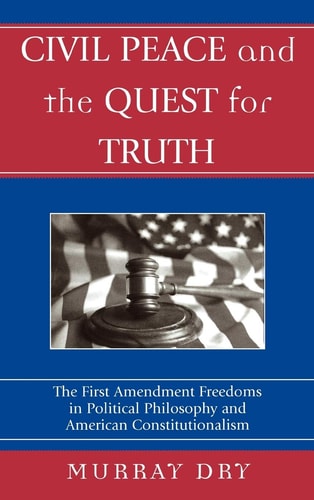
Civil Peace and the Quest for Truth: The First Amendment Freedoms in Political Philosophy and American Constitutionalism
0
0
As an Amazon Associate and affiliate partner, Menrva Books earns from qualifying purchases. Learn more
Author Description
The freedoms of speech and religion assumed a sacrosanct space in American notions of civil liberty. But it was not until the twentieth century that these freedoms became prominent in American constitutional law; originally, the first ten amendments applied only to the federal government and not to the states. Murray Dry traces the trajectory of freedom of speech and religion to the center of contemporary debates as few scholars have done, by looking back to the American founding and to the classical texts in political philosophy that shaped the founders' understanding of republican government. By comparing the colonial charters with the new state constitutions and studying the development of the federal Constitution, Dry demonstrates the shift from governmental concern for the salvation of souls to the more limited aim of the securing of rights. For a uniquely rich and nuanced appreciation of this shift Dry explores the political philosophy of Locke, Spinoza, Montesquieu, and Mill, among others, whose writings helped shaped the Supreme Court's view of religion as separate from philosophy, as a matter of individual faith and not a community practice. Delving into the polyvalent interpretations of such fundamental concepts as truth,faith, and freedom,Civil Peace and the Quest for Truth immeasurably advances the study of American constitutional law and our First Amendment rights.
Menrva's Summary
THE THESIS
This book investigates the historical and philosophical evolution of First Amendment freedoms in American constitutionalism. Murray Dry, a scholar of political philosophy and American constitutionalism, examines how the freedoms of speech and religion, initially applied only to the federal government, became central to American civil liberties by the twentieth century. The work traces this trajectory by analyzing foundational political philosophy from thinkers like Locke, Spinoza, Montesquieu, and Mill, and by comparing colonial charters with state and federal constitutions. Dry demonstrates a significant shift from a governmental focus on the salvation of souls to the more limited objective of securing individual rights, exploring the complex interpretations of truth, faith, and freedom.
THE SCOPE MAP
- Analysis of the philosophical underpinnings of First Amendment freedoms from classical political thought.
- Comparison of colonial charters with early state and federal constitutions.
- Examination of the historical shift in governmental focus from religious salvation to the protection of individual rights.
- Exploration of the political philosophies of Locke, Spinoza, Montesquieu, and Mill as they relate to American constitutionalism.
- Discussion on the evolving interpretation of 'truth', 'faith', and 'freedom' within legal and philosophical contexts.
- Focus on the development of freedom of speech and religion in American constitutional law, particularly in the 20th century.
THE AUTHORITY PERSPECTIVE
The book is recognized for its in-depth analysis of the historical and philosophical roots of First Amendment freedoms, particularly speech and religion. Scholars note its comprehensive comparison of foundational texts in political philosophy with the development of American constitutional law. The work is praised for advancing the study of American constitutionalism by meticulously tracing the shift from a focus on religious salvation to the protection of individual rights. Its exploration of key concepts like truth, faith, and freedom offers a nuanced appreciation of these fundamental liberties.
Page Count:
309
Publication Date:
2004-11-17
Publisher:
Bloomsbury Academic
ISBN-10:
0739107461
ISBN-13:
9780739107461
Politics
History
Non-Fiction
Freedom of religion
Political Philosophy
American History
Freedom of speech
Constitutional Law