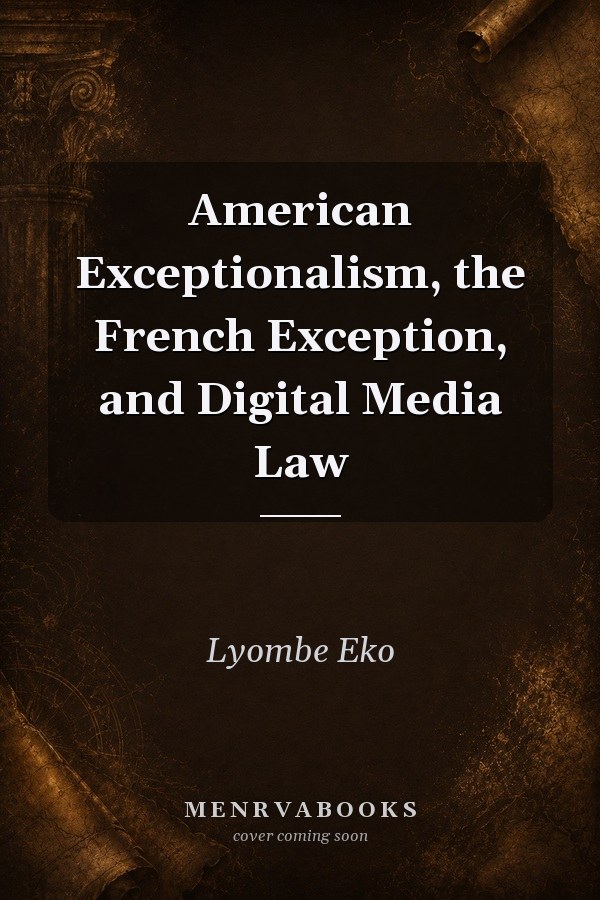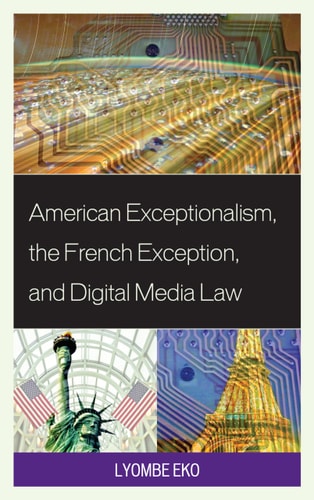
American Exceptionalism, the French Exception, and Digital Media Law
0
0
As an Amazon Associate and affiliate partner, Menrva Books earns from qualifying purchases. Learn more
Author Description
This volume explores the sameness and difference between the United States and France in the matters of freedom of expression on the Internet. The United States and France are liberal democracies that are part of the Western family of nations. However, despite their many similarities, they have a number of cultural and ideological differences. The United States is generally France’s ally in time of war and its cultural nemesis in time of peace. One of the reasons for this unusual relationship is that the United States and France are self-described “exceptional” countries. The United States and France are therefore two Western countries separated by different exceptionalist logics. Lyombe Eko uses this concept of exceptionalism as a theoretical framework for the analysis of American and French resolution of problems of human rights and freedom of expression in the traditional media and on the Internet. This book therefore analyzes how each county applies rules and regulations designed to manage a number of issues of media communication in real space, to the realities and specificities of cyberspace, within the framework of their respective exceptionalist logics. The fundamental question addressed concerns what happens when rules and regulations designed to regulate the media in clearly defined, national and regional geographic spaces, are suddenly confronted with the new realities and multi-communication platforms of the interconnected virtual sphere of cyberspace.
Menrva's Summary
THE THESIS
This volume investigates the divergent approaches of the United States and France to freedom of expression on the internet, framed by their respective national exceptionalist logics. The book analyzes how two liberal democracies, despite shared Western values, apply traditional media regulations to the unique challenges of cyberspace. It explores the cultural and ideological differences that shape their distinct
THE SCOPE MAP
- Analysis of freedom of expression in the US and France concerning digital media.
- Exploration of the concept of national exceptionalism as a theoretical framework.
- Comparison of how traditional media rules are adapted to cyberspace realities.
- Examination of human rights and freedom of expression issues in both countries.
- Discussion of the challenges posed by interconnected virtual spheres to national regulations.
- Focus on the application of media communication rules to the internet.
THE AUTHORITY PERSPECTIVE
The book offers a comparative legal and cultural analysis, utilizing the concept of exceptionalism to understand differing national approaches to digital media law. It is likely to appeal to scholars and students of media law, comparative politics, and international relations who are interested in the intersection of technology, freedom of expression, and national identity. The work provides a theoretical lens for examining how distinct cultural and ideological underpinnings influence regulatory frameworks in the digital age. Its focus on the United States and France offers a specific, yet broadly applicable, case study for understanding global challenges in cyberspace governance.
Page Count:
330
Publication Date:
2017-09-11
Publisher:
Bloomsbury Academic
ISBN-10:
1498557171
ISBN-13:
9781498557177
Non-Fiction
Politics
History
Freedom Of Expression
Media Law
Comparative Law
Digital Media
American Studies
French Studies
Community Tags
Similar Books