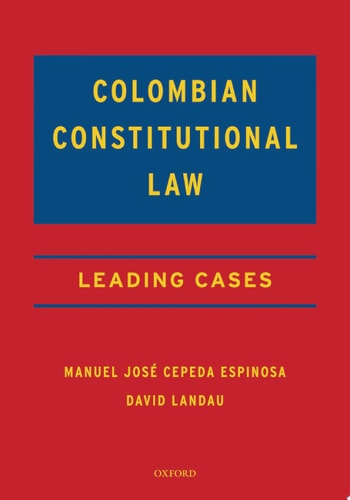
Colombian Constitutional Law: Leading Cases
0
0
As an Amazon Associate and affiliate partner, Menrva Books earns from qualifying purchases. Learn more
Author Description
This book provides in English the case law of the Colombian Constitutional Court, which has become one of the most creative and important courts of the global south and the world since its creation in 1991. It offers concise and carefully chosen extracts of the Court's most important cases, along with notes and introductory materials to place them in historical and comparative context. The book covers the Court's landmark rights jurisprudence, including the decriminalization of drug possession, the legalization of same-sex marriage, the protection of social rights through broad structural orders such as the ones covering internally displaced persons and the right to health. It also covers the protection of the rights of indigenous peoples to cultural autonomy and to be consulted before economic projects are undertaken on their land, and the rights of victims of the country's long-running internal armed conflict to truth, justice, and reparations. Also provided are the Court's most noteworthy structural cases, particularly its successful attempt to limit the use of states of exception and its substitution of the constitution doctrine, which allows it to strike down amendments that replace rather than amending core principles of the existing constitutional order. The materials focus on the Court's contributions in a comparative perspective, showing how they are exemplary of a range of problems faced by courts around the world and particularly as an example of aggressive judicial review by the courts of the global south. At the same time, they demonstrate how many of the Court's key cases - such as the judicial review of the peace process with guerrilla groups or the striking down of an amendment to allow a popular president to seek a third term - are reactions to the historical features of the Colombian legal and social landscape.
Menrva's Summary
THE THESIS
This volume investigates the role and impact of the Colombian Constitutional Court as a primary agent of judicial innovation within the Global South. Authors David E. Landau and Manuel José Cepeda Espinosa utilize a curated selection of landmark case law to demonstrate how the Court has navigated complex social, political, and historical challenges since its inception in 1991. The text argues that the Court's jurisprudence serves as a critical model for understanding aggressive judicial review in emerging democracies.
THE SCOPE MAP
What You Will Find
- Extracts of landmark rulings regarding drug possession, same-sex marriage, and social rights.
- Analysis of structural orders concerning internally displaced persons and the right to health.
- Examination of the 'substitution of the constitution' doctrine and limitations on states of exception.
- Comparative perspectives on judicial responses to internal armed conflict and peace processes.
Scope Limits
- The text does not provide an exhaustive history of the entire Colombian legal system.
- It focuses primarily on the Constitutional Court rather than lower-level civil or criminal court procedures.
THE AUTHORITY PERSPECTIVE
Legal scholars and practitioners identify this work as a vital resource for understanding the influence of the Colombian Constitutional Court on global jurisprudence. Experts highlight the clarity of the comparative analysis, noting that the text is well-suited for both academic study and professional reference.
Page Count:
448
Publication Date:
2017-03-27
Publisher:
Oxford University Press
ISBN-10:
0190640367
ISBN-13:
9780190640361
Constitutional Law
Human rights
American Studies
Law
Professional Career & Trade
Comparative Law
Law_colombia
Community Tags
Similar Books