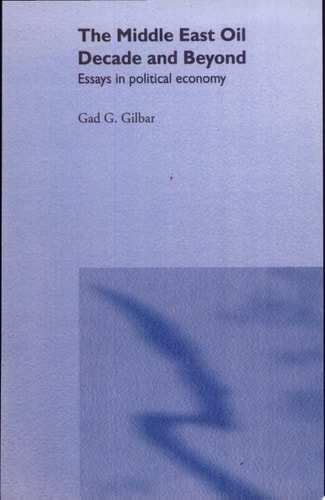
The Middle East Oil Decade and Beyond: Essays in Political Economy
0
0
As an Amazon Associate and affiliate partner, Menrva Books earns from qualifying purchases. Learn more
Author Description
The sudden, huge price hikes in Middle Eastern oil in late 1973 yielded, almost overnight, an enormous flow of resources to states and societies that could not have anticipated such instant affluence. With this came unprecedented political power because of the control the oil states were able to maintain over oil production and prices until the second half of 1982. Thus, though covering barely nine years, the period may appropriately be dubbed the "Oil Decade". In this study of fundamental aspects of the oil decade, Gad G. Gilbar first examines the influence the production, export and revenues of oil exerted on domestic, regional and international relations. This is followed by an in-depth analysis of the expansion of higher education, no doubt the single most significant social change the oil decade engendered. Throughout the Arab world many new universities began opening their doors to an ever-increasing number of students, especially in the sciences and civil engineering. Significant also was the proportion of women students enrolling. Finally, the author traces how, as of the early 1970s, the official Arab boycott on goods manufactured in Israel was increasingly being circumvented, and a wide range of agricultural and industrial products were beginning to find their way to customers in Arab states.
Menrva's Summary
THE THESIS
The sudden, massive price increases in Middle Eastern oil during late 1973 dramatically reshaped global power dynamics and resource distribution. This period, dubbed the "Oil Decade," saw unprecedented political power accrue to oil-producing states due to their control over production and prices until the mid-1980s. The book examines the profound influence of oil production, export, and revenues on domestic, regional, and international relations. It also details the significant social change of expanding higher education across the Arab world, with a notable increase in female enrollment, and analyzes the circumvention of the Arab boycott on Israeli goods.
THE SCOPE MAP
- Analysis of the influence of oil production, export, and revenues on domestic, regional, and international relations.
- In-depth examination of the expansion of higher education in the Arab world during the Oil Decade.
- Focus on the significant increase in the proportion of women students enrolling in universities.
- Investigation into the circumvention of the Arab boycott on goods manufactured in Israel.
- Discussion of the flow of agricultural and industrial products to customers in Arab states.
- Exploration of the unprecedented political power gained by oil-producing states.
- Examination of the impact of instant affluence on societies that could not anticipate such wealth.
THE AUTHORITY PERSPECTIVE
This study is regarded as a foundational text for understanding the economic and political transformations in the Middle East during the late 20th century. The author's detailed analysis of the "Oil Decade" highlights its profound and lasting impact on regional and international relations. The book is noted for its comprehensive scope, covering not only the economic shifts but also the significant social changes, particularly the expansion of higher education and increased female enrollment. Furthermore, its exploration of evolving trade dynamics and the circumvention of boycotts offers critical insights into the period's complex geopolitical landscape.
Page Count:
123
Publication Date:
1997-01-01
Publisher:
Psychology Press
ISBN-10:
0714647349
ISBN-13:
9780714647340
Economics
History
Non-Fiction
Sociology
Community Tags
Similar Books