
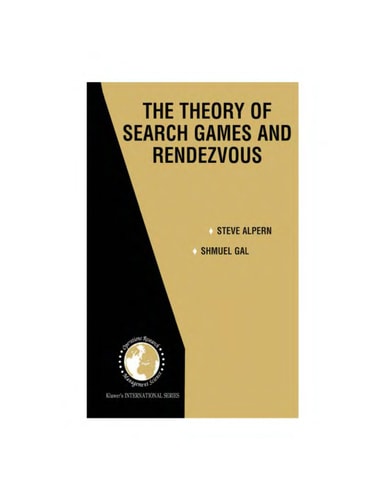
The Theory of Search Games and Rendezvous
0
0
As an Amazon Associate and affiliate partner, Menrva Books earns from qualifying purchases. Learn more
Author Description
Search Theory is one of the original disciplines within the field of Operations Research. It deals with the problem faced by a Searcher who wishes to minimize the time required to find a hidden object, or “target. ” The Searcher chooses a path in the “search space” and finds the target when he is sufficiently close to it. Traditionally, the target is assumed to have no motives of its own regarding when it is found; it is simply stationary and hidden according to a known distribution (e. g., oil), or its motion is determined stochastically by known rules (e. g., a fox in a forest). The problems dealt with in this book assume, on the contrary, that the “target” is an independent player of equal status to the Searcher, who cares about when he is found. We consider two possible motives of the target, and divide the book accordingly. Book I considers the zero-sum game that results when the target (here called the Hider) does not want to be found. Such problems have been called Search Games (with the “ze- sum” qualifier understood). Book II considers the opposite motive of the target, namely, that he wants to be found. In this case the Searcher and the Hider can be thought of as a team of agents (simply called Player I and Player II) with identical aims, and the coordination problem they jointly face is called the Rendezvous Search Problem.
Menrva's Summary
THE THESIS
This book investigates the strategic interactions between a searcher and a target, where the target actively influences the outcome of the search. The authors explore two primary scenarios: the zero-sum game where the target aims to evade detection, and the cooperative problem where both parties aim to meet. The work builds upon the foundational principles of Search Theory, extending it to situations involving independent, motivated players.
THE SCOPE MAP
- The foundational principles and historical development of Search Theory within Operations Research.
- Analysis of "Search Games" where the target (Hider) actively attempts to avoid being found.
- Examination of the "Rendezvous Search Problem" where the searcher and target have aligned goals and must coordinate to meet.
- Mathematical models and game-theoretic frameworks for analyzing these search scenarios.
- Discussion of different search spaces and target behaviors, including stationary, stochastically moving, and independently motivated targets.
THE AUTHORITY PERSPECTIVE
The book presents a specialized area of Operations Research, focusing on game-theoretic approaches to search problems. Its content is likely to appeal to academics and researchers in mathematics, computer science, and operations research who are interested in strategic decision-making under uncertainty. The structured division into two distinct types of search problems suggests a comprehensive treatment of the subject matter.
Page Count:
319
Publication Date:
2013-04-16
Publisher:
Springer US
ISBN-10:
1475777949
ISBN-13:
9781475777949
Non-Fiction
Science
Game theory
Operations Research
Probability
Mathematics
Community Tags
Other Editions(4)


Similar Books









Reader Comments
Share Your Thoughts
No comments yet. Be the first to share your thoughts!