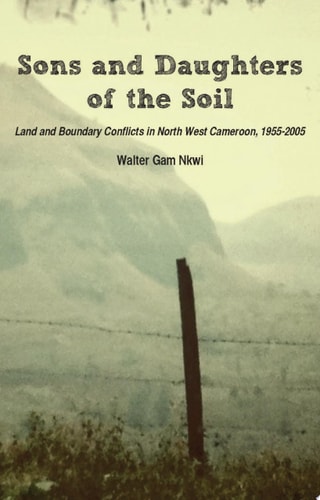
Sons and Daughters of the Soil: Land and Boundary Conflicts in North West Cameroon, 1955-2005
0
0
As an Amazon Associate and affiliate partner, Menrva Books earns from qualifying purchases. Learn more
Author Description
This book makes a rare and original contribution on the history of little documented internal land conflicts and boundary misunderstandings in Cameroon, where attention has tended to focus too narrowly on international boundary conflicts such as that between Cameroon and Nigeria. The study is of the Bamenda Grassfields, the region most plagued by land and boundary conflicts in the country. Despite claims of common descent and cultural similarities by most communities in the region, relations have been tested and dominated by recurrent land and boundary conflicts since the middle of the 20th Century. Nkwi takes us through these contradictions, as he draws empirically and in general on his rich historical and ethnographic knowledge of the tensions and conflicts over land and boundaries in the region to situate and understand the conflicts between Bambili and Babanki-Tungoh the epicenter of land and boundary from c.1950s 2009. Little if any scholarly attention has focused on this all important issue, its pernicious effects on the region notwithstanding. This book takes a bold step in the direction of the social history of land and boundary conflicts in Cameroon, and demonstrates that there is much of scholarly interest in understanding the centrality of land and boundaries in the configuration and contestation of human relations. In his innovative and stimulating blend of history and ethnography, Nkwi points to exciting new directions of paying closer attention to relationships informed by consciousness on and around land and boundaries.
Menrva's Summary
THE THESIS
This book investigates the persistent and often overlooked internal land and boundary conflicts within North West Cameroon, specifically the Bamenda Grassfields, from 1955 to 2005. The study addresses the historical paradox of communities with shared descent and culture engaging in recurrent disputes over land and boundaries. Drawing on extensive historical and ethnographic knowledge, the author focuses on the Bambili and Babanki-Tungoh conflict as a central case study, demonstrating the critical role of land and boundaries in shaping human relations and societal structures in the region.
THE SCOPE MAP
- Analysis of internal land and boundary conflicts in North West Cameroon, a region often overshadowed by international border disputes.
- Focus on the Bamenda Grassfields, identified as the most conflict-prone area in Cameroon regarding land and boundaries.
- Exploration of the contradictions between claims of common descent and the reality of recurrent land disputes among communities.
- Detailed examination of the Bambili and Babanki-Tungoh conflict as a microcosm of land and boundary contestations, spanning from the mid-20th century to 2009.
- Integration of historical and ethnographic methodologies to understand the social history of land and boundary conflicts.
- Highlighting the scholarly neglect of this crucial issue and its significant impact on the region.
- Demonstration of the centrality of land and boundaries in the configuration and contestation of human relations.
- New directions for research emphasizing consciousness and relationships centered around land and boundaries.
THE AUTHORITY PERSPECTIVE
This book offers a rare and original contribution to the understanding of internal land and boundary conflicts in Cameroon, a topic frequently neglected in favor of international border disputes. The work is noted for its empirical depth, drawing on the author's extensive historical and ethnographic knowledge of the Bamenda Grassfields. It highlights the complex interplay between shared cultural heritage and persistent conflict over land, providing a detailed case study of the Bambili and Babanki-Tungoh disputes. The book is recognized for its innovative approach in blending history and ethnography to illuminate the social history of land and boundary contestations.
Page Count:
246
Publication Date:
2011-01-01
Publisher:
Langaa RPCIG
ISBN-10:
9956579076
ISBN-13:
9789956579075
Non-Fiction
History
Africa
Social History
Land Rights
Conflict Studies
Cameroon
Community Tags
Similar Books