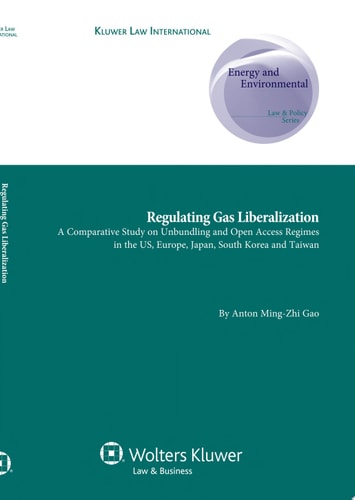
Regulating Gas Liberalization: A Comparative Study on Unbundling and Open Access Regimes in the US, Europe, Japan, South Korea, and Taiwan
0
0
As an Amazon Associate and affiliate partner, Menrva Books earns from qualifying purchases. Learn more
Author Description
This is the first book to analyze, in a comparative way, the detailed development of the unbundling and open access regimes across three continents. It is the author's contention that these two legal forms should be more widely implemented than they are at present. In each of five substantial chapters - on the United States, Europe, Japan, South Korea, and Taiwan - the author first focuses on the proposed or current laws and industrial practices on service, account, functional, legal and ownership unbundling and independent system operator, and then on those of different open access regimes (mainly including regulated and negotiated third party access), insofar as they have been developed in each location. Using empirical evidence from Europe, the United States, and Japan that a well-formulated and comprehensive liberalization can bring about more advantages than disadvantages, he shows how well-designed unbundling and open access regimes may accomplish the following: * inject much-needed competition into gas exploration, exploitation, import, production, and retailing; * reform and re-regulate non-competitive sectors such as transportation, distribution, and storage; * balance potential conflicts between energy security and competition; and * support interests such as environmental protection, energy rights, safety, and consumer protection.
Menrva's Summary
THE THESIS
This book investigates the comparative development of unbundling and open access regimes in the gas industry across the United States, Europe, Japan, South Korea, and Taiwan. The author, Anton Ming-Zhi Gao, argues for the wider implementation of these legal forms, drawing on detailed analysis of proposed and current laws and industrial practices. The study examines various types of unbundling, including service, account, functional, legal, and ownership unbundling, alongside independent system operators, and different open access regimes such as regulated and negotiated third-party access. By presenting empirical evidence, the book demonstrates how well-designed liberalization can introduce competition, reform non-competitive sectors, balance energy security with competition, and support broader interests like environmental protection and consumer rights.
THE SCOPE MAP
- Detailed analysis of unbundling and open access regimes in the gas industry.
- Comparative study across the United States, Europe, Japan, South Korea, and Taiwan.
- Examination of service, account, functional, legal, and ownership unbundling.
- Discussion of independent system operators and various open access models (regulated and negotiated third-party access).
- Empirical evidence from Europe, the United States, and Japan on the advantages of liberalization.
- Arguments for reforming and re-regulating non-competitive sectors like transportation, distribution, and storage.
- Analysis of how liberalization can balance energy security and competition.
- Exploration of support for environmental protection, energy rights, safety, and consumer protection.
THE AUTHORITY PERSPECTIVE
The book is presented as a comprehensive comparative study, offering a detailed analysis of gas industry liberalization across key global regions. Its strength lies in the author's contention that unbundling and open access regimes, when well-formulated, offer more advantages than disadvantages. The work aims to provide empirical evidence to support its arguments for increased competition and regulatory reform within the gas sector. It addresses complex issues such as balancing energy security with market competition and integrating broader societal interests.
Page Count:
416
Publication Date:
2010-01-01
Publisher:
Kluwer Law International B.V.
ISBN-10:
904113347X
ISBN-13:
9789041133472
Politics
Economics
Non-Fiction
Regulation
Energy policy
Gas industry
Comparative Law
Community Tags
Similar Books