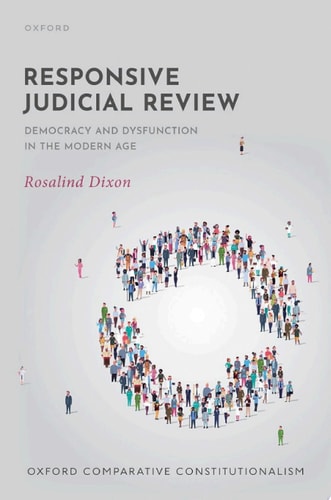
Responsive Judicial Review: Democracy and Dysfunction in the Modern Age
0
0
As an Amazon Associate and affiliate partner, Menrva Books earns from qualifying purchases. Learn more
Author Description
Democratic dysfunction can arise in both 'at risk' and well-functioning constitutional systems. It can threaten a system's responsiveness to both minority rights claims and majoritarian constitutional understandings. Responsive Judicial Review aims to counter this dysfunction using examples from both the global north and global south, including leading constitutional courts in the US, UK, Canada, India, South Africa, and Colombia, as well as select aspects of the constitutional jurisprudence of courts in Australia, Fiji, Hong Kong, and Korea. In this book, Dixon argues that courts should adopt a sufficiently 'dialogic' approach to countering relevant democratic blockages and look for ways to increase the actual and perceived legitimacy of their decisions—through careful choices about their framing, and the timing and selection of cases. By orienting judicial choices about constitutional construction toward promoting democratic responsiveness, or toward countering forms of democratic monopoly, blind spots, and burdens of inertia, judicial review helps safeguard a constitutional system's responsiveness to democratic majority understandings. The idea of 'responsive' judicial review encourages courts to engage with their own distinct institutional position, and potential limits on their own capacity and legitimacy. Dixon further explores the ways that this translates into the embracing of a 'weakened' approach to judicial finality, compared to the traditional US-model of judicial supremacy, as well as a nuanced approach to the making of judicial implications, a 'calibrated' approach to judicial scrutiny or judgments about proportionality, and an embrace of 'weak – strong' rather than wholly weak or strong judicial remedies. Not all courts will be equally well-placed to engage in review of this kind, or successful at doing so. For responsive judicial review to succeed, it must be sensitive to context-specific limitations of this kind. Nevertheless, the idea of responsive
Menrva's Summary
THE THESIS
How can judicial review be structured to effectively counter democratic dysfunction while maintaining institutional legitimacy? Professor Rosalind Dixon examines the intersection of constitutional law and democratic health, arguing that courts must adopt a dialogic approach to address systemic blockages. Drawing on a comparative analysis of constitutional jurisprudence across the global north and south, Dixon proposes a framework where judicial review is calibrated to promote responsiveness to majority understandings while mitigating democratic monopolies and inertia.
THE SCOPE MAP
What You Will Find
- Comparative analysis of constitutional courts in the US, UK, Canada, India, South Africa, and Colombia.
- Theoretical framework for 'responsive' judicial review versus traditional judicial supremacy.
- Methodologies for judicial framing, timing, and case selection to enhance legitimacy.
- Strategies for 'weak-strong' judicial remedies and calibrated proportionality.
Scope Limits
- Does not provide a universal blueprint applicable to all political systems regardless of local context.
- Does not cover the entirety of constitutional law beyond the specific focus on democratic responsiveness.
THE AUTHORITY PERSPECTIVE
Legal scholars and practitioners identify this work as a significant contribution to the field of comparative constitutionalism. Experts frequently highlight the text's utility in bridging the gap between abstract democratic theory and the practical, institutional constraints faced by modern high courts.
Page Count:
307
Publication Date:
2023-01-01
Publisher:
OUP Oxford
ISBN-10:
0192689711
ISBN-13:
9780192689719
Politics
Comparative Law
Professional Career & Trade
Law
Democracy
Systems Theory
Constitutional Law
Judicial System
Community Tags
Similar Books