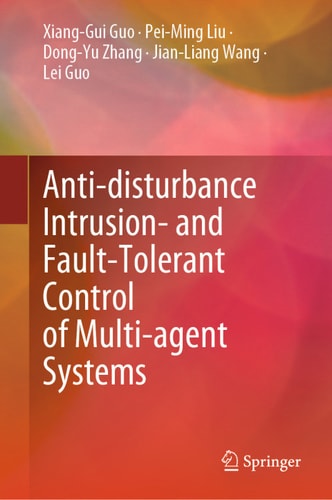
Anti-Disturbance Intrusion- and Fault-Tolerant Control of Multi-Agent Systems
0
0
As an Amazon Associate and affiliate partner, Menrva Books earns from qualifying purchases. Learn more
Author Description
This book focuses on anti-disturbance intrusion- and fault-tolerant consensus control for MASs. The main feature of this book is the successful introduction of event-triggered distributed adaptive feedback control methodology, observer technology, and sliding mode technology to solve the problem of anti-disturbance, intrusion-tolerant, and fault-tolerant control of MAS. Meanwhile, pinning control strategies are proposed to realize the cluster consensus control of MAS. In addition, based on the Nussbaum function, the fault-tolerant control problems of different types of MASs subjected to time-varying unknown nonidentical direction (TVUND) faults are investigated. This book provides a coherent approach and contains valuable reference materials for researchers who wish to explore the area of MAS. Researchers, graduate students, and engineers in the fields of electrical engineering, control engineering, applied mathematics, computer science, and others will benefit from this book.
Menrva's Summary
THE THESIS
This book investigates the challenges of achieving consensus in multi-agent systems (MAS) under conditions of external disturbances, cyber intrusions, and internal component faults. It presents novel methodologies for anti-disturbance, intrusion-tolerant, and fault-tolerant control by integrating event-triggered distributed adaptive feedback control, observer technology, and sliding mode technology. The work also explores pinning control strategies for cluster consensus and addresses fault-tolerant control for various MAS types subjected to time-varying unknown non-identical direction faults using Nussbaum functions.
THE SCOPE MAP
- Event-triggered distributed adaptive feedback control methodology for MAS.
- Observer and sliding mode technologies for disturbance, intrusion, and fault tolerance.
- Pinning control strategies for cluster consensus in MAS.
- Fault-tolerant control for MAS with time-varying unknown non-identical direction (TVUND) faults.
- Application of Nussbaum functions in fault-tolerant control.
- Coherent approach to complex control problems in multi-agent systems.
THE AUTHORITY PERSPECTIVE
This book offers a specialized and advanced treatment of control theory for multi-agent systems, focusing on resilience against disturbances, intrusions, and faults. Its methodologies, particularly the integration of event-triggered control and sliding mode techniques, are designed for researchers and engineers seeking robust solutions in complex networked systems. The detailed investigation into TVUND faults and the use of Nussbaum functions suggest a rigorous theoretical framework beneficial for advanced study and practical application in fields like robotics, distributed computing, and network control.
Page Count:
302
Publication Date:
2025-11-07
Publisher:
Springer Nature Singapore
ISBN-10:
9819696135
ISBN-13:
9789819696130
Non-Fiction
Science
Applied Mathematics
Computer Science
Control Engineering