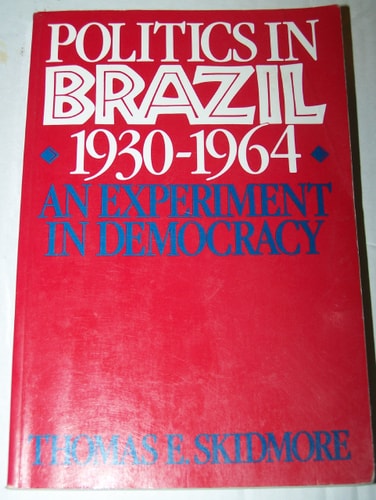
Politics in Brazil, 1930-1964: An Experiment in Democracy
0
0
As an Amazon Associate and affiliate partner, Menrva Books earns from qualifying purchases. Learn more
Author Description
This book follows three decades of democratic experimentation--and the rise and fall of constitutional government--in Brazil. Beginning with Getulio Vargas' fifteen-year rule and ending with the coup d'etat that ousted President Joao Goulart from office in 1964, Skidmore sets political events in the context of social and economic factors to show how the problems posed by economic expansion, an unfavorable trade balance, inequitable land distribution, and shifting political power have profoundly affected Brazil's growth and stability.
Menrva's Summary
THE THESIS
This work investigates the factors that contributed to the rise and eventual collapse of democratic governance in Brazil between 1930 and 1964. Thomas E. Skidmore, a prominent historian of Latin America, utilizes a comprehensive historical framework to analyze the intersection of political shifts, economic pressures, and social instability. By examining the period from the Vargas era to the 1964 coup, the author argues that structural economic challenges and persistent social inequality fundamentally undermined the stability of constitutional rule in the nation.
THE SCOPE MAP
What You Will Find
- A detailed historical analysis of the Getulio Vargas administration and its long-term political impact.
- Examination of economic variables including trade balances, land distribution, and industrial expansion.
- Primary source analysis of the political maneuvers leading to the 1964 coup d'etat.
- A contextual study of how shifting power dynamics influenced Brazilian national stability.
THE AUTHORITY PERSPECTIVE
Experts and historians frequently cite this work as a foundational text for understanding the complexities of mid-twentieth-century Brazilian politics. Readers often note the academic density of the prose, which provides a rigorous and thorough examination of the period's political evolution.
Page Count:
464
Publication Date:
1986-08-28
Publisher:
Oxford University Press
ISBN-10:
0195007840
ISBN-13:
9780195007848
History
Politics
Government
Politics & Government