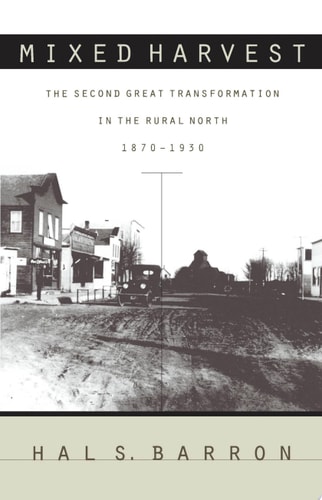
Mixed Harvest: The Second Great Transformation in the Rural North, 1870-1930
0
0
As an Amazon Associate and affiliate partner, Menrva Books earns from qualifying purchases. Learn more
Author Description
Mixed Harvest explores rural responses to the transformation of the northern United States from an agricultural society into an urban and industrial one. According to Hal S. Barron, country people from New England to North Dakota negotiated the rise of large-scale organizational society and consumer culture in ways marked by both resistance and accommodation, change and continuity. Between 1870 and 1930, communities in the rural North faced a number of challenges. Reformers and professionals sought to centralize authority and diminish local control over such important aspects of rural society as schools and roads; large-scale business corporations wielded increasing market power, to the detriment of independent family farmers; and an encroaching urban-based consumer culture threatened rural beliefs in the primacy of their local communities and the superiority of country life. But, Barron argues, by reconfiguring traditional rural values of localism, independence, republicanism, and agrarian fundamentalism, country people successfully created a distinct rural subculture. Consequently, agrarian society continued to provide a counterpoint to the dominant trends in American society well into the twentieth century.
Menrva's Summary
THE THESIS
This book investigates how rural communities in the northern United States adapted to the profound societal shifts from an agrarian to an industrial and urban landscape between 1870 and 1930. Hal S. Barron, drawing on extensive historical research, details the challenges faced by these communities, including the centralization of authority by reformers, the increasing market power of corporations, and the encroachment of urban consumer culture. The book argues that despite these pressures, rural inhabitants successfully navigated these changes by reconfiguring traditional values, thereby forging a distinct rural subculture that persisted as a counterpoint to dominant American trends.
THE SCOPE MAP
- An examination of rural responses to industrialization and urbanization in the northern US.
- Analysis of the period between 1870 and 1930, covering New England to North Dakota.
- Discussion of challenges posed by reformers, corporations, and urban consumer culture.
- Exploration of how rural communities negotiated resistance and accommodation to societal changes.
- Argument for the creation of a distinct rural subculture through the reconfiguration of traditional values.
- Consideration of the persistence of agrarian society as a counterpoint to dominant American trends.
THE AUTHORITY PERSPECTIVE
Hal S. Barron's "Mixed Harvest" is recognized for its detailed exploration of the complex transformations in rural America during a pivotal era. The book is noted for its nuanced argument that rural communities, far from being passive victims of modernization, actively shaped their own identities and subcultures. Scholars have pointed to Barron's synthesis of regional experiences, from New England to North Dakota, as a significant contribution to understanding the persistence of rural distinctiveness. The work is considered a valuable resource for understanding the interplay between tradition and modernity in American history.
Page Count:
320
Publication Date:
2000-11-09
Publisher:
The University of North Carolina Press
ISBN-10:
0807860263
ISBN-13:
9780807860267
Non-Fiction
History
Rural Studies
Social History
American History
Community Tags
Other Editions(2)
Similar Books