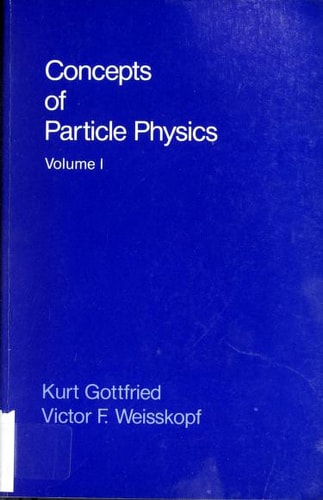
Concepts of Particle Physics: Volume II
0
0
As an Amazon Associate and affiliate partner, Menrva Books earns from qualifying purchases. Learn more
Author Description
The second volume of this authoritative work traces the material outlined in the first, but in far greater detail and with a much higher degree of sophistication. The authors begin with the theory of the electromagnetic interaction, and then consider hadronic structure, exploring the accuracy of the quark model by examining the excited states of baryons and mesons. They introduce the color variable as a prelude to the development of quantum chromodynamics, the theory of the strong interaction, and go on to discuss the electroweak interaction--the broken symmetry of which they explain by the Higgs mechanism--and conclude with a consideration of grand unification theories.
Menrva's Summary
THE THESIS
This volume investigates the theoretical frameworks governing particle interactions, specifically focusing on the transition from electromagnetic theory to quantum chromodynamics and grand unification. The authors, both distinguished physicists, utilize a rigorous mathematical approach to detail the structure of hadrons and the mechanisms behind electroweak symmetry breaking. By building upon the foundational concepts established in the first volume, the text provides a comprehensive analysis of the forces that define the subatomic landscape.
THE SCOPE MAP
What You Will Find
- Detailed analysis of electromagnetic interaction theory and hadronic structure.
- Examination of the quark model through the study of excited states of baryons and mesons.
- Introduction of the color variable as a foundational element for quantum chromodynamics.
- Theoretical exploration of the Higgs mechanism and grand unification theories.
THE AUTHORITY PERSPECTIVE
Experts recognize this work as a high-level, sophisticated resource for advanced students and researchers in theoretical physics. Readers frequently note the intense mathematical density and the requirement for a strong background in quantum mechanics to fully grasp the presented material.
Page Count:
448
Publication Date:
1986-11-13
Publisher:
Oxford University Press
ISBN-10:
0195033930
ISBN-13:
9780195033939
Science
Particle Physics
Nuclear Physics
Physics
textbook