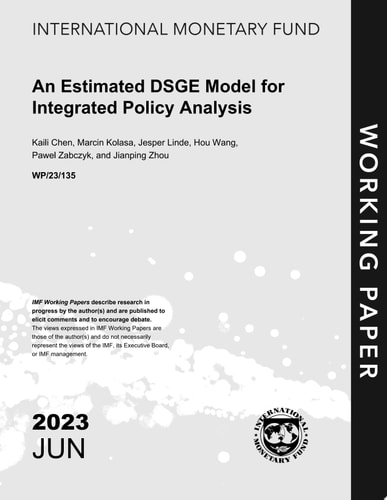
An Estimated DSGE Model for Integrated Policy Analysis
0
0
As an Amazon Associate and affiliate partner, Menrva Books earns from qualifying purchases. Learn more
Author Description
We estimate a New Keynesian small open economy model which allows for foreign exchange (FX) market frictions and a potential role for FX market interventions for a large set of emerging market economies (EMEs) and some inflation targeting (IT) advanced economy (AE) countries serving as a control group. Next, we use the estimated model to examine the empirical support for the view that interest rate policy may not be sufficient to stabilize output and inflation following capital outflow shocks, and the extent to which FX interventions (FXI) can improve policy tradeoffs. Our results reveal significant structural differences between AEs and EMEs—in particular FX market depth—leading to different transmission of capital outflow shocks which justifies occasional use of FXI in some EMEs in certain situations. Our analysis also highlights the critical importance of accounting for the endogeneity of FXI behavior when assessing FX market depth and policy tradeoffs associated with volatile capital flows in past episodes.
Menrva's Summary
THE THESIS
This paper estimates a New Keynesian small open economy model to analyze the impact of foreign exchange market frictions and interventions on policy effectiveness in emerging market economies. The authors utilize a model that incorporates these frictions to examine a large set of emerging market economies (EMEs) and a control group of inflation-targeting advanced economies (AEs). The research investigates whether interest rate policy alone is sufficient to stabilize output and inflation after capital outflow shocks, and quantifies the extent to which foreign exchange interventions (FXI) can alter policy tradeoffs. The findings reveal significant structural differences between AEs and EMEs, particularly in FX market depth, which influences shock transmission and can justify the occasional use of FXI in specific EME contexts.
THE SCOPE MAP
- Estimation of a New Keynesian small open economy model.
- Inclusion of foreign exchange (FX) market frictions and potential for FX interventions.
- Analysis of a large set of emerging market economies (EMEs) and inflation targeting (IT) advanced economy (AE) countries.
- Examination of empirical support for interest rate policy sufficiency following capital outflow shocks.
- Assessment of the role of FX interventions in improving policy tradeoffs.
- Identification of significant structural differences between AEs and EMEs, especially FX market depth.
- Analysis of how FX market depth affects the transmission of capital outflow shocks.
- Highlighting the importance of accounting for the endogeneity of FXI behavior.
THE AUTHORITY PERSPECTIVE
The analysis presented in this paper highlights significant structural differences between advanced economies and emerging market economies, particularly concerning foreign exchange market depth. These differences lead to varied transmission mechanisms for capital outflow shocks, suggesting that foreign exchange interventions may be justified in certain situations for some EMEs. The study underscores the critical need to consider the endogeneity of foreign exchange intervention behavior when evaluating market depth and policy tradeoffs associated with volatile capital flows.
Page Count:
64
Publication Date:
2023-06-30
Publisher:
International Monetary Fund
ISBN-13:
9798400245763
Economics
Non-Fiction
Econometrics
Macroeconomics
Community Tags
Similar Books