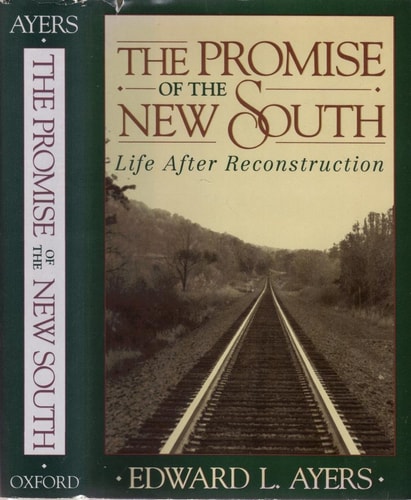
The Promise of the New South: Life After Reconstruction
0
0
As an Amazon Associate and affiliate partner, Menrva Books earns from qualifying purchases. Learn more
Author Description
At a public picnic in the South in the 1890s, a young man paid five cents for his first chance to hear the revolutionary Edison talking machine. He eagerly listened as the soundman placed the needle down, only to find that through the tubes he held to his ears came the chilling sounds of a lynching. In this story, with its blend of new technology and old hatreds, genteel picnic and mob violence, Edward Ayers captures the history of the South in the years between Reconstruction and the turn of the century--a combination of progress and reaction that defined the contradictory promise of the New South.Ranging from the Georgia coast to the Tennessee mountains, from the power brokers to tenant farmers, Ayers depicts a land of startling contrasts--a time of progress and repression, of new industries and old ways. Ayers takes us from remote Southern towns, revolutionized by the spread of the railroads, to the statehouses where Democratic "Redeemers" swept away the legacy of Reconstruction; from the small farmers, trapped into growing nothing but cotton, to the new industries of Birmingham; from abuse and intimacy in the family to tumultuous public meetings of the prohibitionists. He explores every aspect of society, politics, and the economy, detailing the importance of each in the emerging New South. Here is the local Baptist congregation, the country store, the tobacco-stained second-class railroad car, the rise of Populism: the teeming, nineteenth-century South comes to life in these pages. And central to the entire story is the role of race relations, from alliances and friendships between blacks and whites to the spread of Jim Crow laws and disenfranchisement. Ayers weaves all these details into the contradictory story of the New South, showing how the region developed the patterns it was to follow for the next fifty years.When Edward Ayers published Vengeance and Justice, a landmark study of crime and punishment in the nineteenth-century South, he received wide accla
Menrva's Summary
THE THESIS
This work investigates the complex, contradictory evolution of the American South during the period between the end of Reconstruction and the turn of the twentieth century. Edward L. Ayers, a prominent historian of the American South, utilizes a vast array of primary sources, including personal accounts, local records, and economic data, to construct a comprehensive analysis of the region. He argues that the "New South" was defined by a volatile mixture of rapid industrial modernization and the entrenchment of regressive social hierarchies, particularly regarding race relations and political disenfranchisement.
THE SCOPE MAP
What You Will Find
- Detailed examination of the socio-economic transition from agrarian dependence to industrialization in states like Georgia and Tennessee.
- Analysis of the political mechanisms used by "Redeemers" to dismantle Reconstruction-era reforms.
- Extensive use of primary source material, including personal narratives, local newspapers, and legislative records.
- Exploration of the intersection between technological advancement and the hardening of racial segregation through Jim Crow laws.
THE AUTHORITY PERSPECTIVE
Historians and scholars widely recognize this text as a foundational study for understanding the structural and social shifts in the post-Reconstruction South. Readers frequently note the academic density of the prose, which provides a rigorous and nuanced look at the region's development.
Page Count:
592
Publication Date:
1992-09-17
Publisher:
Oxford University Press
ISBN-10:
0195037561
ISBN-13:
9780195037562
History
Social History
Southern History
Political History
Southern States
Reconstruction Era
Community Tags
Other Editions(2)
Similar Books














Reader Comments
Share Your Thoughts
No comments yet. Be the first to share your thoughts!