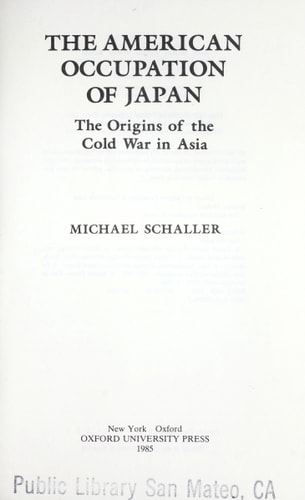
The American Occupation of Japan: The Origins of the Cold War in Asia
0
0
As an Amazon Associate and affiliate partner, Menrva Books earns from qualifying purchases. Learn more
Author Description
This book provides a novel perspective on the origins of the Cold War in Asia, tracing it all the way back to the occupation of Japan after the Second World War. Schaller argues that the reconstruction of postwar Japan not only shaped the future of that country but the future of U.S. policy throughout postwar Asia, leading up to the controversial interventions in China, Korea, and Vietnam.The author shows how after the war, the United States sought to develop Japan as a stable bulwark against both Soviet expansion and Asian revolution. Schaller depicts the intense contest that raged among Americans, pitting the flamboyant Occupation Commander, General Douglas MacArthur, against virtually all civilian and military planners in Washington, including the president. First hailed as a hero and given nearly free reign to shape Japan's future, MacArthur was ultimately denounced by Truman and his advisors as a "bunko artist" who had wrecked Japan's economy and opened it to Communist influence. In place of MacArthur's ambitious social and economic reforms, the new Occupation program reconcentrated power in the hands of Japans's old elite. The book shows how Communist control of China and North Korea cut Japan off from its historic trading partners and forced officials to focus on developing the rich but unstable Southeast Asian states. Washington feared that economic blackmail alone would pull Japan into the Soviet orbit. Determined to secure Japan--the ultimate "domino"--the United States spurned possible detente with China, extended military aid to the French in Indochina, and finally entered the Korean War.
Menrva's Summary
THE THESIS
This work investigates how the post-World War II occupation of Japan served as the primary catalyst for the development of United States Cold War policy across the Asian continent. Michael Schaller, a professor of history at the University of Arizona, utilizes extensive archival research and primary documentation to examine the shift from initial reformist occupation goals to the strategic prioritization of Japan as an anti-communist bulwark. The text argues that the internal conflict between General Douglas MacArthur and Washington policymakers fundamentally redirected American interventionism in China, Korea, and Vietnam.
THE SCOPE MAP
What You Will Find
- Analysis of the transition from democratic reform to the restoration of Japan's pre-war elite.
- Examination of the geopolitical impact of the Chinese Revolution on Japanese trade relations.
- Primary source documentation detailing the friction between General MacArthur and the Truman administration.
- A strategic framework explaining the origins of the domino theory in Southeast Asia.
THE AUTHORITY PERSPECTIVE
Historians and political scientists frequently cite this text as a foundational analysis of the intersection between occupation policy and broader Cold War strategy. Readers often note the dense, evidence-heavy nature of the prose, which provides a rigorous look at the bureaucratic and military decision-making processes of the era.
Page Count:
363
Publication Date:
1985-11-14
Publisher:
Oxford University Press
ISBN-10:
0195036263
ISBN-13:
9780195036268
History
Asian History
Japan
United States
Military History
Cold War
International relations
Community Tags
Similar Books