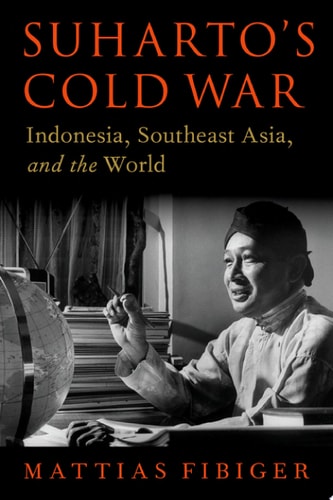
Suharto's Cold War: Indonesia, Southeast Asia, and the World
0
0
As an Amazon Associate and affiliate partner, Menrva Books earns from qualifying purchases. Learn more
Author Description
After the murder of senior generals in the Indonesian army by elements of the country's communist party in 1965, General Suharto orchestrated the mass killing of some half a million leftists and fellow travelers. But his ambitions spanned far beyond perpetrating a politicide. Seeking to ensure that communism could never again take root in the archipelago, he constructed a New Order to reverse Indonesia's descent into political instability and economic crisis.Based on unprecedented access to Indonesian archives and a wealth of international sources, Suharto's Cold War masterfully narrates the first decades of the Suharto regime at the national, regional, and global levels. Suharto mobilized international aid and investment to build his counterrevolutionary dictatorship and ignite processes of economic development. He then aimed to project authoritarianism elsewhere in Southeast Asia by assisting right-wing dictators across the region. International capital made available through the global Cold War enabled Suharto to achieve the dictatorial and developmental ambitions that lay at the heart of his domestic and regional Cold Wars. Material realities at home and abroad disciplined Suharto's political project, while political considerations in Indonesia and around the world shaped his economic programs.Paying close attention to the interrelationship between the domestic and the international, the political and the economic, Suharto's Cold War makes a pathbreaking contribution to understanding Indonesia, Southeast Asia, and the world.
Menrva's Summary
THE THESIS
This work investigates how General Suharto utilized the global dynamics of the Cold War to consolidate his domestic power and project authoritarian influence across Southeast Asia. Mattias Fibiger, a scholar of international history, draws upon previously restricted Indonesian archives and extensive international documentation to analyze the intersection of economic development and political repression. The book argues that Suharto’s regime was not merely a local phenomenon but a calculated project that leveraged international capital and anti-communist sentiment to stabilize his rule and export his model of governance to neighboring states.
THE SCOPE MAP
What You Will Find
- Analysis of the 1965 political transition and the subsequent mass killings of leftists.
- Examination of the relationship between international aid, foreign investment, and the construction of the New Order.
- Documentation of Suharto’s efforts to support right-wing dictatorships throughout Southeast Asia.
- A synthesis of domestic political constraints and global Cold War economic pressures.
THE AUTHORITY PERSPECTIVE
Scholars recognize this text as a significant contribution to the study of Indonesian history due to its reliance on previously inaccessible archival materials. The prose is noted for its academic rigor and its ability to connect local political developments to broader international trends.
Page Count:
384
Publication Date:
2023-07-07
Publisher:
Oxford University Press
ISBN-10:
0197667228
ISBN-13:
9780197667224
History
Biography
Cold War
International relations
Asian History
Asia history
Community Tags
Similar Books