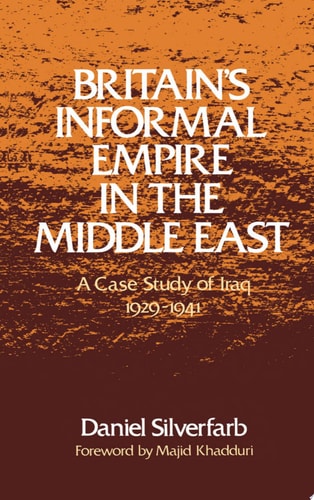
Britain's Informal Empire in the Middle East: A Case Study of Iraq, 1929-1941
0
0
As an Amazon Associate and affiliate partner, Menrva Books earns from qualifying purchases. Learn more
Author Description
This is a penetrating account of Anglo-Iraqi relations from 1929, when Britain decided to grant independence to Iraq, to 1941, when hostilities between the two nations came to an end. Showing how Britain tried--and failed--to maintain its political influence, economic ascendancy, and strategic position in Iraq after independence, Silverfarb presents a suggestive analysis of the possibilities and limitations of indirect rule by imperial powers in the Third World. The book also tells of the rapid disintegration of Britain's dominance in the Middle East after World War I and portrays the struggle of a recently independent Arab nation to free itself from the lingering grip of a major European power.
Menrva's Summary
THE THESIS
This work investigates the mechanisms and ultimate failure of British informal imperialism in Iraq during the critical transition period between 1929 and 1941. Daniel Silverfarb, drawing upon extensive archival research and historical documentation, examines the strategic, economic, and political maneuvers employed by the British government to maintain hegemony over a nominally independent state. The text argues that the inherent contradictions of indirect rule rendered Britain's influence unsustainable, leading to the eventual collapse of its regional dominance.
THE SCOPE MAP
What You Will Find
- Analysis of Anglo-Iraqi diplomatic relations from the 1929 independence decision to the 1941 conflict.
- Examination of the economic and strategic instruments used to exert indirect control.
- Evaluation of the limitations of imperial power in post-colonial state-building.
- Case study of the disintegration of British influence in the Middle East following World War I.
THE AUTHORITY PERSPECTIVE
Historians and political scientists frequently cite this work as a foundational text for understanding the complexities of British foreign policy in the interwar period. The prose is noted for its academic rigor and its clear-eyed assessment of the structural failures of imperial governance.
Page Count:
210
Publication Date:
1986-06-12
Publisher:
Oxford University Press
ISBN-10:
0195039971
ISBN-13:
9780195039979
History
International relations
Iraq
Military History
Colonialism
Community Tags
Similar Books