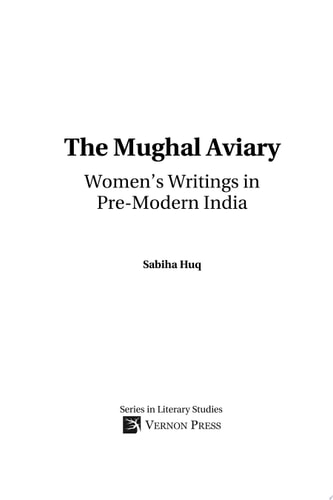
The Mughal Aviary: Women’s Writings in Pre-Modern India
0
0
As an Amazon Associate and affiliate partner, Menrva Books earns from qualifying purchases. Learn more
Author Description
This volume delves into the literary lives of four Muslim women in pre-modern India. Three of them, Gulbadan Begam (1523-1603), the youngest daughter of Emperor Babur, Jahanara (1614-1681), the eldest daughter of Emperor Shah Jahan, and Zeb-un-Nissa (1638-1702), the eldest daughter of Emperor Aurangzeb, belonged to royalty. Thus, they were inhabitants of the Mughal 'zenana', an enigmatic liminal space of qualified autonomy and complex equations of gender politics. Amidst such constructs, Gulbadan Begam’s 'Humayun-Nama' (biography of her half-brother Humayun, reflecting on the lives of Babur’s wives and daughters), Jahanara’s hagiographies glorifying Mughal monarchy, and Zeb-un-Nissa’s free-spirited poetry that landed her in Aurangzeb’s prison, are discursive literary outputs from a position of gendered subalternity. While the subjective selves of these women never much surfaced under extant rigid conventions, their indomitable understanding of ‘home-world’ antinomies determinedly emerge from their works. This monograph explores the political imagination of these Mughal women that was constructed through statist interactions of their royal fathers and brothers, and how such knowledge percolated through the relatively cloistered communal life of the 'zenana'. The fourth woman, Habba Khatoon (1554-1609), famously known as ‘the Nightingale of Kashmir’, offers an interesting counterpoint to her royal peers. As a common woman who married into royalty (her husband Yusuf Shah Chak was the ruler of Kashmir in 1579-1586), her happiness was short-lived with her husband being treacherously exiled by Emperor Akbar. Khatoon’s verse, which voices the pangs of separation, was that of an ascetic who allegedly roamed the valley, and is famed to have introduced the ‘lol’ (lyric) into Kashmiri poetry. Across genres and social positions of all these writers, this volume intends to cast hitherto unfocused light on the emergent literary sensibilities shown by Muslim women in pre-modern In
Menrva's Summary
THE THESIS
This volume investigates the literary contributions and political imaginations of four Muslim women in pre-modern India, exploring their works within the socio-political contexts of the Mughal era. The author, Sabiha Huq, examines the writings of three royal women—Gulbadan Begam, Jahanara, and Zeb-un-Nissa—who navigated the complexities of the Mughal 'zenana', and contrasts them with the verse of Habba Khatoon, a common woman who married into royalty. The monograph analyzes how these women, despite societal constraints and gendered subalternity, expressed their understanding of 'home-world' antinomies and constructed political ideas through their interactions with statist power structures.
THE SCOPE MAP
- Analysis of Gulbadan Begam's 'Humayun-Nama', focusing on its reflection of Babur's family and the lives of women.
- Examination of Jahanara's hagiographies and their glorification of Mughal monarchy.
- Study of Zeb-un-Nissa's free-spirited poetry and its consequences within Aurangzeb's court.
- Exploration of Habba Khatoon's verse, which voices separation and is credited with introducing the 'lol' (lyric) into Kashmiri poetry.
- Investigation into the political imagination of these women, shaped by their interactions with royal fathers and brothers.
- Analysis of how knowledge and literary sensibilities percolated through the 'zenana' and communal life.
- Comparison of the literary outputs and social positions of royal women versus Habba Khatoon.
THE AUTHORITY PERSPECTIVE
This volume is likely to be regarded as a significant contribution to the study of pre-modern Indian women's literature and history, offering a focused examination of previously under-highlighted voices. The author's detailed analysis of the chosen writers, spanning royal and non-royal backgrounds, provides a nuanced perspective on gender, power, and literary expression within the Mughal context. The work's strength lies in its comparative approach, casting new light on emergent literary sensibilities from a period where such contributions are often obscured.
Page Count:
204
Publication Date:
2022-04-15
Publisher:
Vernon Press
ISBN-10:
1648894275
ISBN-13:
9781648894275
Biography
History
Non-Fiction
Literary Criticism
Community Tags
Similar Books