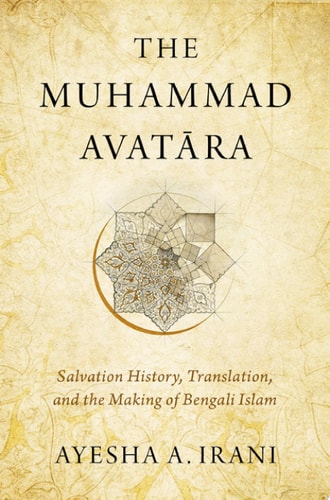
The Muhammad Avatara: Salvation History, Translation, and the Making of Bengali Islam
0
0
As an Amazon Associate and affiliate partner, Menrva Books earns from qualifying purchases. Learn more
Author Description
In The Muhammad Avatara, Ayesha Irani offers an examination of the Nabivamsa, the first epic work on the Prophet Muhammad written in Bangla. This little-studied seventeenth-century text, written by Saiyad Sultan, is a literary milestone in the multi-ethnic, multi-cultural history of Islam, and marks a significant contribution not only to Bangla's rich literary corpus, but also to our understanding of Islam's localization in Indic culture in the early modern period. That Sufis such as Saiyad Sultan played a central role in Islam's spread in Bengal has been demonstrated primarily through examination of medieval Persian literary, ethnographic, and historical sources, as well as colonial-era data. Islamic Bangla texts themselves, which emerged from the sixteenth century, remain scarcely studied outside the Bangladeshi academy, and almost entirely untranslated. Yet these premodern works, which articulate Islamic ideas in a regional language, represent a literary watershed and underscore the efforts of rebel writers across South Asia, many of whom were Sufis, to defy the linguistic cordon of the Muslim elite and the hegemony of Arabic and Persian as languages of Islamic discourse. Irani explores how an Arabian prophet and his religion came to inhabit the seventeenth-century Bengali landscape, and the role that pir-authors, such as Saiyad Sultan, played in the rooting of Islam in Bengal's easternmost regions. This text-critical study lays bare the sophisticated strategies of translation used by a prominent early modern Muslim Bengali intellectual to invite others to his faith.
Menrva's Summary
THE THESIS
How did the seventeenth-century Bengali poet Saiyad Sultan translate the life of the Prophet Muhammad into a regional vernacular to facilitate the localization of Islam in Bengal? Ayesha A. Irani, a scholar of South Asian religions, utilizes a text-critical approach to analyze the Nabivamsa, arguing that this epic work represents a deliberate effort by Sufi intellectuals to bypass the linguistic hegemony of Arabic and Persian. By examining the linguistic and cultural strategies employed by Sultan, Irani demonstrates how Islamic theology was adapted to fit the specific socio-cultural landscape of early modern Bengal.
THE SCOPE MAP
What You Will Find
- Analysis of the seventeenth-century Bengali epic Nabivamsa
- Examination of Sufi literary strategies in South Asia
- Historical context regarding the spread of Islam in eastern Bengal
- Discussion of translation methodologies used by early modern Muslim intellectuals
Scope Limits
- The study focuses primarily on the Nabivamsa and does not provide a comprehensive survey of all medieval Bengali Islamic literature
- The analysis is limited to the specific cultural and linguistic context of seventeenth-century Bengal
THE AUTHORITY PERSPECTIVE
Scholars recognize this work as a significant contribution to the study of vernacular Islamic literature and the history of religion in South Asia. Experts frequently highlight the text for its rigorous analysis of previously understudied primary sources and its nuanced approach to the intersection of language and faith.
Page Count:
450
Publication Date:
2020-01-01
Publisher:
Oxford University Press
ISBN-10:
0190089245
ISBN-13:
9780190089245
Religion
History
Cultural History
Asian Studies
Islam
Literary Criticism
Asian History
Community Tags
Similar Books