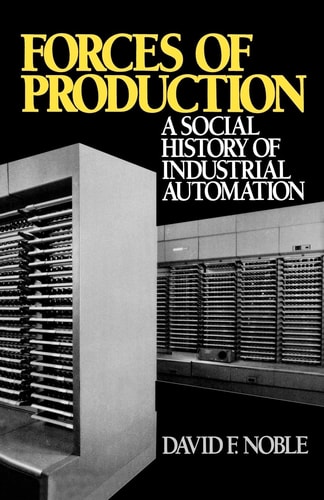
Forces of Production: A Social History of Industrial Automation
0
0
As an Amazon Associate and affiliate partner, Menrva Books earns from qualifying purchases. Learn more
Author Description
Focusing on the postwar automation of the American metal-working industry--the heart of the modern industrial economy--this is a provocative study of how automation has assumed a critical role in America. David Noble argues that industrial automation--more than merely a technological advance--is a social process that reflects very real divisions and pressures within our society. The book explains how technology is often spurred and shaped by the military, corporations, universities, and other mighty institutions. Using detailed case studies, Noble also demonstrates how engineering design is influenced by political, economic, and sociological considerations, and how the deployment of equipment is frequently entangled with certain managerial concerns.
Menrva's Summary
THE THESIS
This book investigates the social and political forces that dictate the trajectory of industrial automation rather than viewing technological progress as an inevitable, neutral evolution. David F. Noble, a historian of technology, examines the postwar American metal-working industry to argue that engineering choices are rarely dictated by efficiency alone. Instead, he demonstrates that the development of automated systems is deeply embedded in the power dynamics between corporations, the military, and academic institutions, often prioritizing managerial control over labor autonomy.
THE SCOPE MAP
What You Will Find
- Analysis of the postwar American metal-working industry as a primary case study.
- Examination of the influence of military and corporate funding on engineering design.
- Historical documentation of the shift toward numerical control systems in manufacturing.
- Exploration of how institutional power structures shape the implementation of new technology.
THE AUTHORITY PERSPECTIVE
Scholars and historians frequently cite this work as a foundational text for understanding the social construction of technology. Readers often note the dense, analytical nature of the prose, which provides a rigorous critique of industrial development.
Page Count:
427
Publication Date:
1986-02-25
Publisher:
Oxford University Press
ISBN-10:
0195040465
ISBN-13:
9780195040463
History
Economics
Sociology
Technology
Community Tags
Similar Books