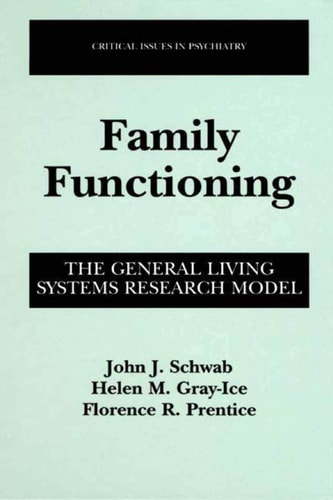
Family Functioning: The General Living Systems Research Model
0
0
As an Amazon Associate and affiliate partner, Menrva Books earns from qualifying purchases. Learn more
Author Description
The family, that most fundamentalof human groups, is currently perceived to be changing in response to social, biological, cultural and technological developments in our postmodernsociety. While the observed changes in families have been considered by some sociologists to be evidence of adaptation and, therefore, normal, the authors of this volume, consider them maladaptive. Viewing society from the point of view of clinical psychiatry, they point to greatly increased numbers of children born to single mothers, soaring rates of divorce, a statistically confirmed increase in mental disorders, increase in reported incest, high rates of depression in younger people and escalation of the amount of reported family violence as evidence that the family, as a social institution, is in crisis and can either move toward renewed vitality or continued deterioration. Perceiving a need to obtain information about family functioning that might lead to the increased stability and well-being of this critically important type of system, Dr. John Schwab and his associates designed and camed out a research program that began with a thorough review of relevant literature beginning with LePlay’s study of 300 families in the 1850’sand including important recent statistical studies. They found that although these studies represent advances in understanding the family system, some serious problems with the research remain, one of which is confounding variables such as family function and mental or substance abuse disorders so that if a family member has a problem, such as drug abuse, the family is classifiedasdysfunctional.
Menrva's Summary
THE THESIS
The General Living Systems Research Model offers a framework for understanding the crisis facing the modern family. Viewing societal changes through the lens of clinical psychiatry, the authors identify numerous indicators of family deterioration, including rising divorce rates, increased mental disorders, and escalating family violence. They argue that these changes are maladaptive rather than adaptive responses to societal shifts. To address this, a research program was initiated, beginning with a comprehensive review of literature from the 1850s to contemporary studies, aiming to identify factors contributing to family stability and well-being.
THE SCOPE MAP
- Analysis of family functioning through the General Living Systems Research Model.
- Review of historical and contemporary sociological and psychiatric literature on family dynamics.
- Examination of social, biological, cultural, and technological developments impacting families.
- Discussion of maladaptive changes in family structures and their consequences.
- Identification of confounding variables in family research, such as the classification of families based on individual member disorders.
- Proposed research methodologies for assessing family stability and well-being.
THE AUTHORITY PERSPECTIVE
This volume presents a critical analysis of contemporary family structures, arguing that observed changes are indicative of a crisis rather than normal adaptation. The authors, drawing on clinical psychiatry and extensive literature review, propose the General Living Systems Research Model as a tool to understand and potentially improve family functioning. The work highlights methodological challenges in family research, particularly the issue of confounding variables. The book aims to provide insights for increasing the stability and well-being of the family unit.
Page Count:
283
Publication Date:
2013-03-18
Publisher:
Springer US
ISBN-10:
1475773250
ISBN-13:
9781475773255
Psychology
Non-Fiction
Social Science
Sociology
Family Studies
Psychiatry
Community Tags
Other Editions(2)
Similar Books










Reader Comments
Share Your Thoughts
No comments yet. Be the first to share your thoughts!