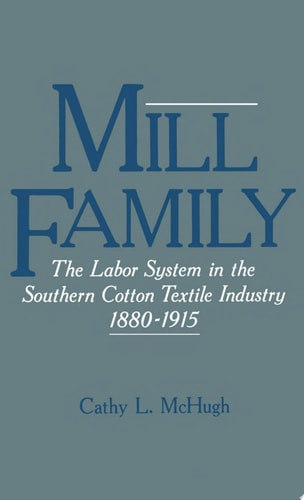
Mill Family: The Labor System in the Southern Cotton Textile Industry, 1880-1915
0
0
As an Amazon Associate and affiliate partner, Menrva Books earns from qualifying purchases. Learn more
Author Description
The growing cotton textile industry of the postbellum South required a stable and reliable work force made up of laborers with varied skills. At the same time, Southern agriculture was in a depressed state. Families, especially those with many children, were therefore forced to look for work in the textile mills. Mill managers, in their own interest, created the basis for a distinctive social and economic structure: the Southern cotton mill village. These villages, which included such accoutrements as good schools for the children, were paternalistic work environments designed to attract this desirable source of workers. This book examines the role of the family labor system in the early evolution of the postbellum Southern cotton textile industry, revealing how the mill village served as a focal point of economic and social cohesion as well as an institution for socializing and stabilizing its workers. The paternalism of the mill villages was not merely an instrument of capitalistic indoctrination, contends McHugh, but was shaped by market forces. McHugh employs a valuable body of archival material from the Alamance Mill, an important cotton textile mill in North Carolina, to illustrate her arguments.
Menrva's Summary
THE THESIS
This book investigates how the family labor system and paternalistic mill village structure facilitated the growth of the Southern cotton textile industry between 1880 and 1915. Cathy L. McHugh, a scholar of economic and labor history, utilizes archival records from the Alamance Mill in North Carolina to challenge the notion that mill paternalism was solely a tool of indoctrination. She argues that these social structures were pragmatic responses to market forces and the necessity of stabilizing a reliable workforce during a period of agricultural depression.
THE SCOPE MAP
What You Will Find
- Analysis of the postbellum Southern cotton textile industry from 1880 to 1915.
- Examination of the family labor system as a primary economic driver.
- Utilization of primary source archival material from the Alamance Mill.
- Investigation into the intersection of paternalistic social structures and market-driven labor management.
THE AUTHORITY PERSPECTIVE
Historians and labor scholars frequently cite this work as a foundational study for understanding the socio-economic dynamics of the Southern industrial transition. Experts highlight the text for its rigorous use of archival data to provide a nuanced view of the relationship between mill management and the labor force.
Page Count:
160
Publication Date:
1988-04-07
Publisher:
Oxford University Press
ISBN-10:
0195042999
ISBN-13:
9780195042993
History
Textile industry
Sociology
United States
Industrial history
Southern History
Economic History
Labor history
Community Tags
Similar Books














