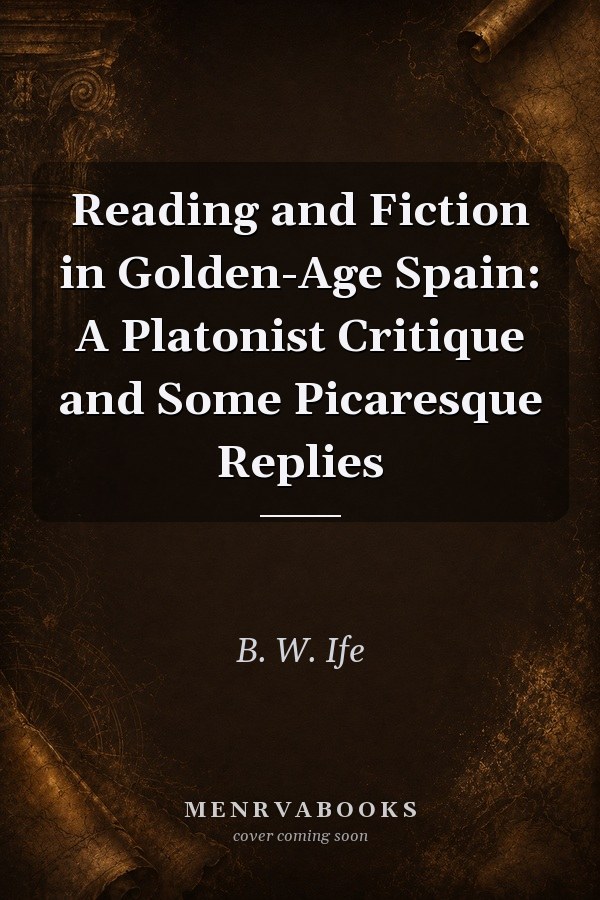
Reading and Fiction in Golden-Age Spain: A Platonist Critique and Some Picaresque Replies
0
0
As an Amazon Associate and affiliate partner, Menrva Books earns from qualifying purchases. Learn more
Author Description
In the Spanish Golden Age, the new literary mode of vernacular prose fiction was deplored by many authorities for setting bad examples, undermining reality by deceiving with lies, and persuading in the face of rational disbelief. Dr Ife here examines the connection between the objections posed to this fiction and those raised two thousand years earlier by Plato. This book shows how the aims and results of 'picaresque' novel writing in fact counter such objections. In a study of three sixteenth- and early seventeenth-century Spanish novels Dr Ife demonstrates that the authors consciously exploited their readers' response to a narrative in order to bring them to a clearer understanding of their own experience. In this way the very process of representation deplored by the Platonist critics may be regarded as having a moral validity of its own. Additional English translations are provided of all the key extracts studied.
Menrva's Summary
THE THESIS
This book investigates the critical reception of vernacular prose fiction in Spain's Golden Age and its relationship to Platonic philosophy. It examines how contemporary authorities condemned new literary forms for their perceived deception and moral corruption, drawing parallels to Plato's ancient objections. The study then demonstrates how the picaresque novel, through its narrative strategies, actively countered these criticisms. By analyzing three key novels from the 16th and 17th centuries, the author argues that these works used the reader's engagement with the narrative to foster a deeper understanding of their own experiences, thereby imbuing the act of representation with its own moral validity.
THE SCOPE MAP
- Analysis of Platonic objections to fiction.
- Examination of the Spanish Golden Age's literary authorities' critiques of vernacular prose fiction.
- Study of the picaresque novel as a response to these criticisms.
- In-depth analysis of three specific 16th
- and early 17th-century Spanish novels.
- Exploration of how narrative representation can possess moral validity.
- Inclusion of additional English translations for key extracts.
THE AUTHORITY PERSPECTIVE
This book is regarded as a scholarly examination of the philosophical and literary debates surrounding fiction in Golden Age Spain. The author's approach connects ancient Platonic thought with early modern Spanish picaresque novels, offering a nuanced perspective on the moral implications of literary representation. It highlights how the picaresque genre, often seen as lowbrow, was in fact a sophisticated response to critical objections. The work provides valuable insights for scholars of Spanish literature and the history of ideas.
Page Count:
0
Publication Date:
2011-01-01
Publisher:
Cambridge University Press
ISBN-10:
0511897928
ISBN-13:
9780511897924
History
Classics
Non-Fiction
Literary Criticism
Spanish literature
Community Tags
Similar Books